
Deutsch: Satellitenfertigung / Español: Fabricación de satélites / Português: Fabricação de satélites / Français: Fabrication de satellites / Italiano: Produzione di satelliti
Satellite Manufacturing refers to the specialized industrial process of designing, assembling, integrating, and testing artificial satellites before their deployment into space. This field combines aerospace engineering, materials science, and advanced manufacturing techniques to produce spacecraft that meet stringent performance, reliability, and environmental requirements. The discipline is critical to telecommunications, Earth observation, scientific research, and national security, with each satellite tailored to its intended orbital mission.
General Description
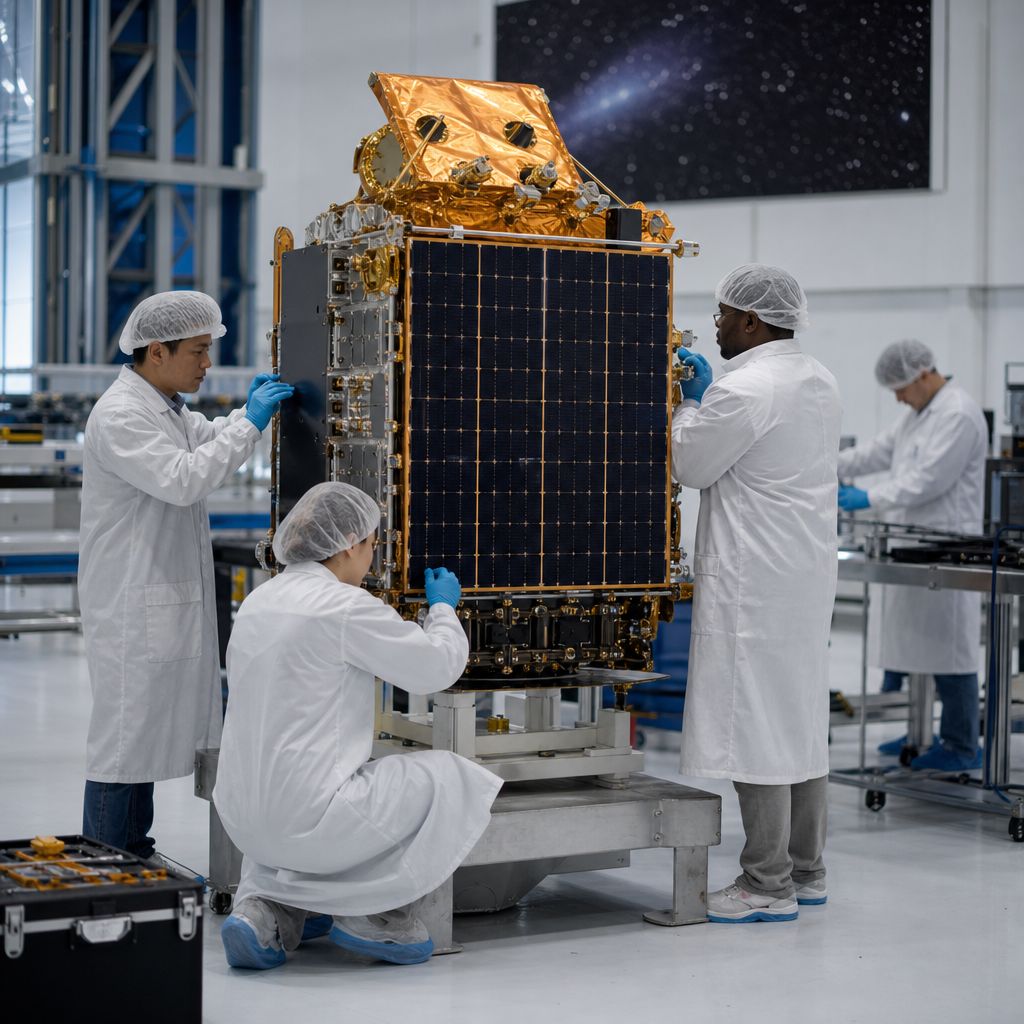
Satellite manufacturing encompasses a multi-stage production cycle that begins with conceptual design and extends through final assembly, environmental testing, and launch preparation. The process is governed by rigorous standards, such as those defined by the European Cooperation for Space Standardization (ECSS) or NASA's technical specifications, to ensure compatibility with launch vehicles and operational environments. Unlike terrestrial manufacturing, satellite production must account for extreme thermal fluctuations, vacuum conditions, and mechanical stresses during launch, necessitating the use of lightweight yet durable materials like carbon-fiber composites, aluminum-lithium alloys, and radiation-hardened electronics.
Key subsystems in satellite manufacturing include the payload, which determines the satellite's primary function (e.g., communication transponders, optical sensors, or scientific instruments); the bus, which provides structural support, power, thermal control, and attitude determination; and the propulsion system, which enables orbital maneuvers. Integration of these components requires cleanroom environments (typically ISO Class 8 or cleaner) to prevent contamination, as even microscopic particles can impair sensitive instruments or solar panels. Testing protocols, such as vibration testing to simulate launch conditions and thermal vacuum testing to replicate space environments, are mandatory to validate performance before launch.
The industry is characterized by high capital expenditure and long development cycles, often spanning 3–7 years for large geostationary satellites. However, the rise of small satellites (e.g., CubeSats) and constellations has introduced modular manufacturing approaches, reducing costs and lead times. Companies like SpaceX, Airbus Defence and Space, and Thales Alenia Space dominate the sector, though emerging players in Asia and private startups are increasingly contributing to innovation in manufacturing efficiency and satellite miniaturization.
Technical Details
Satellite manufacturing relies on precision engineering to balance conflicting requirements: minimizing mass while maximizing structural integrity, power efficiency, and operational lifespan. Materials selection is critical; for example, aluminum-lithium alloys (e.g., Al-Li 2195) are favored for their high strength-to-weight ratio, while carbon-fiber-reinforced polymers (CFRP) are used for antenna reflectors and structural panels due to their thermal stability and low coefficient of thermal expansion. Electronic components must comply with radiation-hardening standards, such as MIL-STD-883 for microelectronics, to withstand cosmic rays and solar particle events.
Assembly processes vary by satellite class. Geostationary satellites (GEO), which operate at altitudes of ~35,786 km, are typically custom-built with lifespans exceeding 15 years, requiring redundant systems and high-capacity power sources (e.g., gallium arsenide solar arrays). In contrast, low Earth orbit (LEO) satellites, including those in mega-constellations like Starlink, are mass-produced using automated assembly lines, with standardized buses and modular payloads to achieve economies of scale. Additive manufacturing (3D printing) is increasingly employed for complex components, such as propulsion system injectors or waveguide filters, reducing weight and production time.
Environmental testing is a non-negotiable phase in satellite manufacturing. Vibration testing, conducted per standards like MIL-STD-810G, simulates the mechanical stresses of launch, while thermal vacuum chambers replicate the temperature extremes and vacuum of space. Electromagnetic compatibility (EMC) testing ensures that subsystems do not interfere with one another, a critical consideration for satellites carrying multiple payloads. For scientific missions, additional tests may include contamination control for optical instruments or calibration of sensors in simulated space conditions.
Historical Development
The evolution of satellite manufacturing reflects broader advancements in space technology. The first artificial satellite, Sputnik 1 (1957), was a rudimentary sphere with minimal instrumentation, assembled by hand in the Soviet Union. Early satellites, such as the U.S. Explorer 1 (1958), were similarly simple, with manufacturing focused on basic functionality rather than longevity. The 1960s and 1970s saw the introduction of geostationary communication satellites, such as Intelsat I (1965), which required more sophisticated thermal control and power systems, marking the beginning of commercial satellite manufacturing.
The 1980s and 1990s brought modular design principles, enabling the reuse of satellite buses (e.g., Boeing's 601 platform) across multiple missions. This period also saw the rise of international collaborations, such as the International Space Station (ISS) modules, which demanded standardized interfaces and rigorous quality control. The 21st century has been defined by two transformative trends: the miniaturization of satellites, exemplified by CubeSats (standardized 10 cm³ units), and the deployment of large constellations, such as OneWeb and Starlink, which rely on mass production techniques borrowed from the automotive and electronics industries.
Application Area
- Telecommunications: Satellites enable global communication networks, including television broadcasting, internet services, and mobile phone connectivity. Geostationary satellites, such as those in the Intelsat fleet, provide continuous coverage over fixed regions, while LEO constellations like Starlink offer low-latency broadband access worldwide.
- Earth Observation: Remote sensing satellites, such as the European Sentinel series or the U.S. Landsat program, monitor environmental changes, natural disasters, and agricultural activity. These satellites carry multispectral or hyperspectral sensors to capture data across various wavelengths, supporting applications in climate science, urban planning, and defense.
- Scientific Research: Satellites like the Hubble Space Telescope or the James Webb Space Telescope (JWST) conduct astronomical observations, while others, such as NASA's Parker Solar Probe, study solar phenomena. Scientific satellites often require highly specialized payloads, such as cryogenic cooling systems for infrared detectors or precision pointing mechanisms for telescopes.
- Navigation: Global Navigation Satellite Systems (GNSS), including the U.S. GPS, Europe's Galileo, and Russia's GLONASS, provide positioning, navigation, and timing services. These systems rely on constellations of medium Earth orbit (MEO) satellites, each equipped with atomic clocks and signal transmitters to achieve meter-level accuracy.
- National Security: Military and intelligence agencies deploy satellites for reconnaissance, early warning systems, and secure communications. Examples include the U.S. Advanced Extremely High Frequency (AEHF) satellites, which provide encrypted communication for strategic commands, and synthetic aperture radar (SAR) satellites for all-weather surveillance.
Well Known Examples
- Intelsat Epic: A series of high-throughput geostationary communication satellites manufactured by Boeing and Maxar Technologies, designed to deliver broadband services with capacities exceeding 25–60 Gbps per satellite. The Epic platform employs advanced digital payloads and frequency reuse techniques to maximize spectral efficiency.
- Starlink (SpaceX): A LEO mega-constellation comprising thousands of small satellites (each weighing ~260 kg) manufactured in-house by SpaceX. The satellites feature phased-array antennas, ion propulsion systems, and autonomous collision avoidance capabilities, enabling global internet coverage with latencies as low as 20 ms.
- Sentinel-2 (ESA): Part of the European Union's Copernicus Earth observation program, Sentinel-2 satellites are manufactured by Airbus Defence and Space. They carry a multispectral instrument with 13 spectral bands, providing high-resolution imagery for land monitoring, disaster response, and climate change studies.
- James Webb Space Telescope (JWST): A collaborative project led by NASA, ESA, and CSA, the JWST is one of the most complex scientific satellites ever built. Its 6.5-meter primary mirror, composed of 18 beryllium segments coated with gold, and cryogenic cooling system enable observations in the infrared spectrum, revolutionizing astronomy.
Risks and Challenges
- Cost Overruns and Schedule Delays: Satellite manufacturing projects frequently exceed budgets and timelines due to technical complexities, supply chain disruptions, or regulatory hurdles. For example, the JWST faced repeated delays and cost increases, ultimately totaling over $10 billion. Such overruns can jeopardize the financial viability of commercial ventures or limit the scope of scientific missions.
- Launch Failures: Despite rigorous testing, satellites remain vulnerable to launch vehicle failures, which can result in total loss. High-profile incidents, such as the 2019 failure of a SpaceX Falcon 9 carrying a Starlink payload or the 2020 Vega rocket failure, underscore the risks inherent in space access. Insurance premiums for satellite launches can exceed 10% of the satellite's value, adding to overall costs.
- Orbital Debris: The proliferation of satellites, particularly in LEO, increases the risk of collisions with space debris, which can damage or destroy operational spacecraft. Mitigation strategies, such as end-of-life deorbiting or active debris removal, are critical but add complexity and cost to satellite design. The 2009 collision between Iridium 33 and Cosmos 2251 highlighted the dangers of unchecked orbital congestion.
- Technological Obsolescence: The long development cycles of traditional satellites (5–10 years) can render their technology outdated by the time of launch. This challenge is particularly acute in the fast-evolving telecommunications sector, where advancements in ground-based infrastructure (e.g., 5G networks) may reduce demand for satellite services. Modular design and software-defined payloads are emerging as solutions to extend satellite relevance.
- Regulatory and Geopolitical Constraints: Satellite manufacturing is subject to stringent export controls, such as the U.S. International Traffic in Arms Regulations (ITAR) or the EU's Dual-Use Regulation, which restrict the transfer of sensitive technologies. Geopolitical tensions can disrupt supply chains, as seen during the 2022 Ukraine conflict, which impacted the availability of Ukrainian-built components for European satellites.
- Environmental and Sustainability Concerns: The production and launch of satellites contribute to carbon emissions and resource depletion. For instance, the aluminum and rare earth metals used in satellite construction have significant environmental footprints. Additionally, the disposal of defunct satellites poses challenges, as uncontrolled re-entries can result in debris falling to Earth, as occurred with the Skylab (1979) and Tiangong-1 (2018) incidents.
Similar Terms
- Spacecraft Manufacturing: A broader category encompassing the production of all vehicles designed for spaceflight, including satellites, probes, landers, and crewed spacecraft. While satellite manufacturing is a subset of spacecraft manufacturing, the latter often involves additional complexities, such as life support systems for crewed missions or planetary entry, descent, and landing (EDL) systems for probes.
- Avionics Manufacturing: Refers to the production of electronic systems used in aerospace applications, including flight control, navigation, and communication systems. In satellite manufacturing, avionics are a critical subsystem, but the term itself is not synonymous with the entire satellite production process.
- CubeSat Development: A specific approach to satellite manufacturing focused on standardized, small-scale satellites (typically 1–10 kg). CubeSats adhere to the CubeSat Design Specification (CDS), which defines form factors (e.g., 1U, 3U, 6U) and interface requirements, enabling cost-effective and rapid deployment for educational, scientific, and commercial purposes.
Summary
Satellite manufacturing is a highly specialized discipline that integrates aerospace engineering, materials science, and advanced production techniques to create spacecraft for diverse applications, from telecommunications to scientific research. The process is defined by stringent standards, environmental testing, and the use of cutting-edge materials to ensure reliability in the harsh conditions of space. While traditional geostationary satellites remain critical for high-capacity missions, the rise of small satellites and mega-constellations has introduced modular and automated manufacturing approaches, reducing costs and accelerating deployment. However, the industry faces significant challenges, including cost overruns, launch risks, orbital debris, and geopolitical constraints, which necessitate ongoing innovation in design, testing, and regulatory compliance. As demand for global connectivity and Earth observation grows, satellite manufacturing will continue to evolve, driven by advancements in miniaturization, propulsion, and in-orbit servicing.
--