
Deutsch: Stratofortress (Raumfahrt) / Español: Stratofortress (industria espacial) / Português: Stratofortress (indústria espacial) / Français: Stratofortress (industrie spatiale) / Italiano: Stratofortress (settore spaziale)
The term Stratofortress in the context of the space industry refers to a conceptual or experimental platform designed for high-altitude operations, often serving as a precursor or complementary system to orbital launch vehicles. While historically associated with the Boeing B-52 Stratofortress strategic bomber, its adaptation for space-related applications involves repurposing or reimagining such aircraft for roles like air-launching payloads, conducting microgravity experiments, or testing hypersonic technologies. These platforms bridge the gap between atmospheric flight and spaceflight, enabling cost-effective access to near-space environments.
General Description
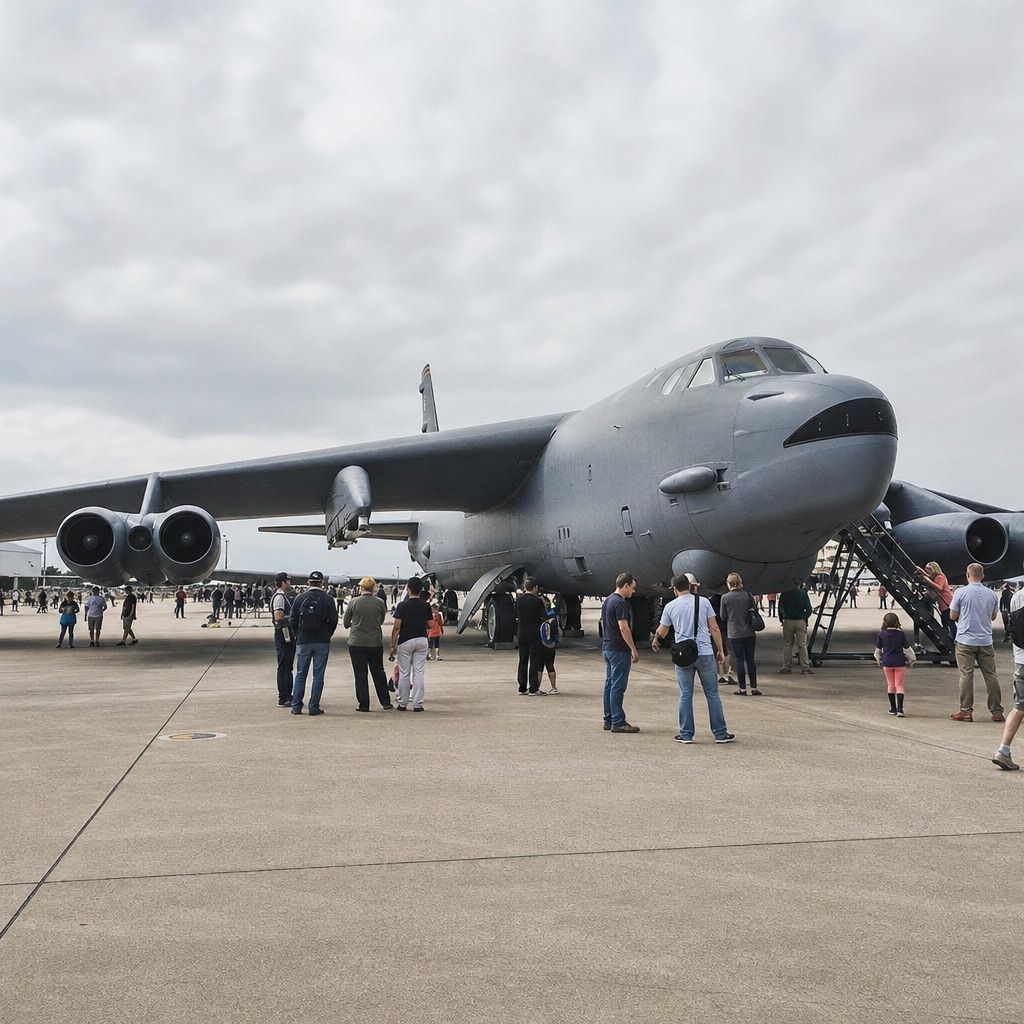
The Stratofortress, when discussed in the space industry, represents a class of high-altitude, long-endurance aircraft repurposed or specifically modified to support space-related missions. Originally developed as a strategic bomber during the Cold War, the Boeing B-52 Stratofortress has demonstrated unparalleled reliability, payload capacity, and operational flexibility, making it a candidate for adaptation in modern aerospace applications. In the space sector, such platforms are often employed as airborne launch systems, where they carry rockets or experimental vehicles to high altitudes before releasing them for suborbital or orbital insertion. This approach reduces the fuel requirements for the launch vehicle, as it bypasses the densest layers of the Earth's atmosphere, thereby improving efficiency and reducing costs.
The operational ceiling of a Stratofortress-derived platform typically exceeds 15,000 meters, placing it within the stratosphere, where atmospheric drag is significantly lower than at sea level. This altitude range is critical for air-launch systems, as it allows the launch vehicle to avoid the most turbulent and energy-intensive phases of ascent. Additionally, the aircraft's extended range and endurance enable it to reach optimal launch coordinates, such as over open ocean or remote areas, where safety and regulatory constraints are less restrictive. The adaptability of the Stratofortress platform also extends to its ability to carry diverse payloads, including scientific instruments, satellite deployment systems, and experimental hypersonic vehicles, making it a versatile tool for both commercial and governmental space programs.
Beyond its role as a launch platform, the Stratofortress has been proposed for use in testing advanced propulsion systems, such as scramjets or combined-cycle engines, which require high-speed, high-altitude conditions to operate effectively. These tests are essential for developing next-generation aerospace technologies, including reusable launch vehicles and hypersonic transport systems. The aircraft's robust airframe and proven flight characteristics provide a stable and controllable environment for such experiments, reducing the risks associated with ground-based or orbital testing. Furthermore, the Stratofortress can serve as a mobile laboratory for studying atmospheric phenomena, such as cosmic radiation or upper-atmospheric chemistry, which are difficult to replicate in terrestrial facilities.
Technical Specifications and Modifications
The Boeing B-52 Stratofortress, the most well-known aircraft associated with this concept, was originally designed in the 1950s as a long-range strategic bomber. Its technical specifications include a wingspan of 56.4 meters, a length of 48.5 meters, and a maximum takeoff weight of approximately 220,000 kilograms. The aircraft is powered by eight turbojet engines, which provide a maximum speed of 1,047 kilometers per hour and a service ceiling of 15,240 meters. For space-related applications, the aircraft undergoes significant modifications, including structural reinforcements to accommodate external payloads, such as rockets or experimental vehicles, and upgrades to its avionics and communication systems to support real-time data transmission and remote operation.
One of the most critical modifications for space applications is the integration of a launch pylon or mounting system, which allows the aircraft to carry and release payloads at high altitudes. This system must be designed to withstand the aerodynamic forces and vibrations associated with high-speed flight, as well as the dynamic loads imposed during payload separation. Additionally, the aircraft's fuel system may be adapted to support extended missions, including aerial refueling capabilities, which are essential for reaching remote launch sites or conducting prolonged test flights. The avionics suite is also upgraded to include advanced navigation and control systems, enabling precise positioning and timing for payload release, which is critical for achieving the desired trajectory and orbital parameters.
In terms of payload capacity, a modified Stratofortress can typically carry external loads of up to 22,700 kilograms, depending on the specific configuration and mission requirements. This capacity is sufficient for launching small to medium-sized satellites, suborbital research vehicles, or experimental hypersonic platforms. The aircraft's ability to carry multiple payloads simultaneously further enhances its utility, as it can support a variety of missions in a single flight, reducing the overall cost and logistical complexity of space operations. For example, the aircraft could deploy a constellation of small satellites in a single sortie, or conduct a series of hypersonic tests with different experimental vehicles.
Historical Development and Space Industry Applications
The use of the Stratofortress in the space industry traces its roots to the early days of the U.S. space program, especially during the X-15 hypersonic research program in the 1960s. The B-52 Stratofortress served as the launch platform for the X-15, an experimental rocket-powered aircraft designed to explore the boundaries of atmospheric flight and space. The X-15 was carried to an altitude of approximately 13,700 meters before being released, after which it ignited its rocket engine to reach speeds of up to Mach 6.7 and altitudes exceeding 100,000 meters. This program demonstrated the feasibility of air-launching high-speed vehicles and provided valuable data for the development of future spaceplanes and reusable launch systems.
Building on this legacy, the Stratofortress has been employed in more recent space-related initiatives, such as the Orbital Sciences Pegasus rocket program. The Pegasus is an air-launched rocket designed to deploy small satellites into low Earth orbit (LEO). It is carried to an altitude of approximately 12,000 meters by a modified B-52 or other high-altitude aircraft before being released and igniting its first-stage motor. This approach offers several advantages over traditional ground-launched rockets, including reduced fuel requirements, greater flexibility in launch locations, and the ability to avoid weather-related delays. The Pegasus program has successfully deployed numerous satellites for both commercial and governmental customers, demonstrating the viability of air-launch systems for cost-effective access to space.
In addition to its role in satellite deployment, the Stratofortress has been proposed for use in testing advanced aerospace technologies, such as hypersonic glide vehicles and scramjet engines. For example, the X-43A, an experimental unmanned hypersonic aircraft, was air-launched from a B-52 Stratofortress as part of NASA's Hyper-X program. The X-43A achieved speeds of up to Mach 9.6, setting a world record for air-breathing aircraft and demonstrating the potential of scramjet propulsion for future space and hypersonic transport systems. These tests are critical for advancing the state of the art in aerospace engineering and paving the way for next-generation vehicles capable of operating at the boundary between atmospheric flight and spaceflight.
Application Area
- Air-Launch Systems: The Stratofortress is primarily used as a platform for air-launching rockets, satellites, and experimental vehicles. By releasing payloads at high altitudes, it reduces the energy required for orbital insertion, improving efficiency and reducing costs. This approach is particularly advantageous for deploying small satellites or conducting suborbital research missions, where traditional ground-launched rockets may be prohibitively expensive or logistically challenging.
- Hypersonic Testing: The aircraft serves as a stable and controllable platform for testing hypersonic vehicles and propulsion systems, such as scramjets or combined-cycle engines. These tests are essential for developing technologies capable of operating at speeds exceeding Mach 5, which are critical for future spaceplanes, reusable launch vehicles, and hypersonic transport systems. The Stratofortress's ability to carry multiple experimental vehicles in a single flight further enhances its utility for hypersonic research.
- Atmospheric Research: The Stratofortress can be equipped with scientific instruments to study upper-atmospheric phenomena, such as cosmic radiation, ozone depletion, or atmospheric chemistry. These studies are difficult to conduct using ground-based or orbital platforms, as they require precise control over altitude and location. The aircraft's extended range and endurance enable it to conduct prolonged observations over remote or inaccessible regions, providing valuable data for climate science and atmospheric research.
- Technology Demonstration: The platform is often used to demonstrate new aerospace technologies, such as advanced materials, guidance systems, or propulsion concepts. By conducting these demonstrations in a real-world environment, researchers can validate their designs and identify potential issues before scaling up to larger or more complex systems. The Stratofortress's proven reliability and adaptability make it an ideal platform for such experiments, reducing the risks and costs associated with technology development.
Well Known Examples
- X-15 Program: The North American X-15 was an experimental rocket-powered aircraft that set speed and altitude records in the 1960s. It was air-launched from a B-52 Stratofortress at an altitude of approximately 13,700 meters, after which it ignited its rocket engine to reach speeds of up to Mach 6.7 and altitudes exceeding 100,000 meters. The X-15 program provided critical data for the development of future spaceplanes and reusable launch systems, including the Space Shuttle.
- Pegasus Rocket: The Orbital Sciences Pegasus is an air-launched rocket designed to deploy small satellites into low Earth orbit. It is carried to an altitude of approximately 12,000 meters by a modified B-52 Stratofortress or other high-altitude aircraft before being released and igniting its first-stage motor. The Pegasus has successfully deployed numerous satellites for both commercial and governmental customers, demonstrating the viability of air-launch systems for cost-effective access to space.
- X-43A Hyper-X Program: The NASA X-43A was an experimental unmanned hypersonic aircraft designed to test scramjet propulsion. It was air-launched from a B-52 Stratofortress and achieved speeds of up to Mach 9.6, setting a world record for air-breathing aircraft. The X-43A program demonstrated the potential of scramjet technology for future space and hypersonic transport systems, paving the way for next-generation aerospace vehicles.
Risks and Challenges
- Payload Separation: One of the primary challenges associated with air-launch systems is ensuring the safe and precise separation of the payload from the carrier aircraft. Aerodynamic forces, vibrations, and dynamic loads during separation can affect the trajectory and stability of the payload, potentially leading to mission failure. Advanced separation mechanisms and real-time monitoring systems are required to mitigate these risks.
- Structural Limitations: The Stratofortress airframe, while robust, was not originally designed for the dynamic loads and stresses associated with carrying and releasing large payloads. Structural reinforcements and modifications are necessary to ensure the aircraft's integrity during high-altitude operations, particularly when carrying heavy or asymmetrical payloads. These modifications can add complexity and cost to the platform.
- Operational Constraints: Air-launch systems are subject to operational constraints, such as weather conditions, airspace regulations, and logistical challenges. For example, adverse weather or restricted airspace can delay or cancel missions, while the need for aerial refueling or extended range can increase operational complexity. These constraints can limit the flexibility and responsiveness of air-launch systems compared to ground-based alternatives.
- Cost and Maintenance: While air-launch systems can reduce the cost of accessing space, the maintenance and operation of a high-altitude aircraft like the Stratofortress can be expensive. The aircraft requires regular inspections, upgrades, and specialized training for its crew, all of which contribute to the overall cost of the platform. Additionally, the limited availability of suitable aircraft can create bottlenecks in launch schedules, further increasing costs.
- Technological Maturity: Many of the technologies associated with air-launch systems, such as hypersonic propulsion or advanced guidance systems, are still in the experimental or developmental stages. The immaturity of these technologies can introduce risks, such as unexpected failures or performance limitations, which may affect the success of the mission. Continued research and development are necessary to address these challenges and improve the reliability of air-launch systems.
Similar Terms
- Air-Launch to Orbit (ALTO): This term refers to the broader concept of launching payloads into orbit from an airborne platform, such as an aircraft or balloon. ALTO systems leverage the altitude and speed of the carrier vehicle to reduce the energy required for orbital insertion, improving efficiency and reducing costs. Examples include the Pegasus rocket and the Stratolaunch system.
- Hypersonic Vehicle: A hypersonic vehicle is an aircraft or spacecraft capable of traveling at speeds exceeding Mach 5. These vehicles are often tested using air-launch platforms like the Stratofortress, as they require high-altitude, high-speed conditions to operate effectively. Examples include the X-15 and the X-43A.
- Reusable Launch Vehicle (RLV): An RLV is a spacecraft or rocket designed to be recovered and reused for multiple missions. While not directly related to the Stratofortress, RLVs often leverage air-launch or high-altitude drop tests to validate their designs and reduce development costs. Examples include the Space Shuttle and the SpaceX Starship.
- Scramjet: A scramjet (supersonic combustion ramjet) is a type of air-breathing engine designed to operate at hypersonic speeds. Scramjets are often tested using air-launch platforms like the Stratofortress, as they require high-speed, high-altitude conditions to function. The X-43A is a notable example of a scramjet-powered vehicle.
Summary
The Stratofortress, particularly in its adapted form as a high-altitude launch platform, plays a pivotal role in the space industry by enabling cost-effective access to near-space environments and facilitating the testing of advanced aerospace technologies. Originally designed as a strategic bomber, the Boeing B-52 Stratofortress has been repurposed for air-launching rockets, hypersonic vehicles, and scientific instruments, demonstrating its versatility and reliability. Its ability to carry heavy payloads to high altitudes reduces the energy requirements for orbital insertion, while its extended range and endurance enable it to reach optimal launch coordinates. However, the platform also faces challenges, including payload separation risks, structural limitations, and operational constraints, which must be addressed to ensure its continued viability in the space sector.
Historical programs like the X-15 and Pegasus have demonstrated the feasibility of air-launch systems, while ongoing initiatives, such as the X-43A, continue to push the boundaries of hypersonic and spaceflight technology. As the space industry evolves, the Stratofortress and similar platforms will remain critical tools for testing, validating, and deploying next-generation aerospace systems, bridging the gap between atmospheric flight and spaceflight.
--
Related Articles to the term 'Stratofortress' | |
| 'Skymaster' | ■■■■■■■ |
| The term Skymaster in the space industry refers to a specialized class of high-altitude, long-endurance . . . Read More | |
| 'LauncherOne' | ■■■■■■■ |
| Deutsch: / Español: LauncherOne / Português: LauncherOne / Français: LauncherOne / Italiano: LauncherOne . . . Read More | |
| 'Terminal' at travel-glossary.com | ■■■■■■ |
| In the travel context, a Terminal refers to a designated, specialized facility within transportation . . . Read More | |
| 'Stratosphere' | ■■■■■■ |
| Stratosphere: The stratosphere is the second layer of the atmosphere of the Earth, located above the . . . Read More | |
| 'Aeroplane' | ■■■■■■ |
| Aeroplane: In the Space industry context, the term \'aeroplane\' isn\'t typically used in its traditional . . . Read More | |
| 'Winches and Cranes' at maritime-glossary.com | ■■■■■■ |
| Winches and Cranes in the maritime context refer to mechanical devices used on ships, offshore platforms, . . . Read More | |
| 'Temperature Control' at maritime-glossary.com | ■■■■■■ |
| Temperature Control in the maritime context refers to the management and regulation of temperature within . . . Read More | |
| 'Globalization' at travel-glossary.com | ■■■■■■ |
| Globalization in the travel context refers to the increasing interconnection and interdependence of nations . . . Read More | |
| 'STCW Certification' at maritime-glossary.com | ■■■■■■ |
| STCW Certification refers to qualifications granted under the International Convention on Standards of . . . Read More | |
| 'High-power' | ■■■■■■ |
| High-power in the Space industry context generally refers to systems or components that operate at or . . . Read More | |
Do you have more interesting information, examples? Send us a new or updated description !
If you sent more than 600 words, which we can publish, we will -if you allow us - sign your article with your name!