
Deutsch: Hubble-Weltraumteleskop / Español: Telescopio Espacial Hubble / Português: Telescópio Espacial Hubble / Français: Télescope spatial Hubble / Italiano: Telescopio Spaziale Hubble
The Hubble Space Telescope (HST) is a landmark observatory in low Earth orbit, revolutionizing astronomy since its deployment in 1990. As a collaboration between NASA and the European Space Agency (ESA), it has provided unprecedented insights into the universe's structure, evolution, and phenomena, free from atmospheric distortion. Its contributions span cosmology, stellar physics, and planetary science, making it one of the most influential scientific instruments in history.
General Description
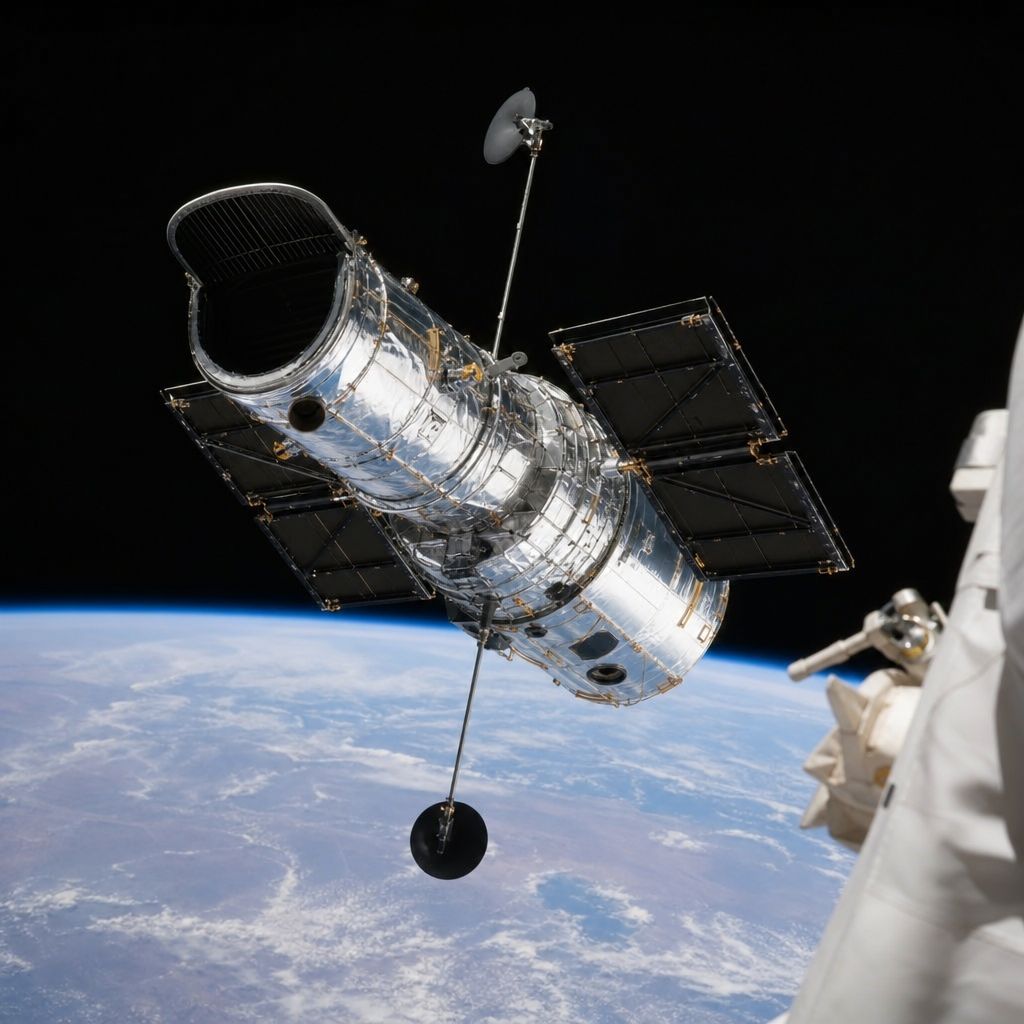
The Hubble Space Telescope is a reflecting telescope with a 2.4-meter primary mirror, designed to observe ultraviolet, visible, and near-infrared wavelengths. Positioned approximately 547 kilometers above Earth's surface, it orbits the planet every 95 minutes, enabling continuous observations without atmospheric interference. This vantage point allows Hubble to capture high-resolution images with a clarity unattainable by ground-based telescopes, which are limited by atmospheric turbulence and light pollution.
The telescope's optical system follows the Ritchey-Chrétien design, a variant of the Cassegrain reflector, which minimizes optical aberrations such as coma and spherical aberration. Its instruments, including the Advanced Camera for Surveys (ACS) and the Wide Field Camera 3 (WFC3), are optimized for specific wavelength ranges, enabling multi-spectral observations. Hubble's data has been instrumental in determining the rate of the universe's expansion, a discovery that led to the Nobel Prize in Physics in 2011 for the identification of dark energy.
Unlike ground-based observatories, Hubble operates in a microgravity environment, which eliminates the need for complex adaptive optics systems to correct for atmospheric distortion. However, its orbital position also exposes it to extreme temperature fluctuations, radiation, and orbital debris, necessitating robust engineering solutions. The telescope's power is supplied by two solar arrays, which convert sunlight into electrical energy, while its attitude control system uses reaction wheels and gyroscopes to maintain precise pointing accuracy.
Technical Specifications
The Hubble Space Telescope's primary mirror has a focal length of 57.6 meters, yielding an angular resolution of approximately 0.04 arcseconds in visible light. This resolution is equivalent to distinguishing two fireflies separated by 3 meters at a distance of 10,000 kilometers. The telescope's instruments cover a wavelength range from 115 nanometers (ultraviolet) to 1.7 micrometers (near-infrared), enabling observations of phenomena such as star formation, galaxy collisions, and exoplanet atmospheres.
Hubble's scientific payload includes five main instruments: the Wide Field Camera 3 (WFC3), the Cosmic Origins Spectrograph (COS), the Space Telescope Imaging Spectrograph (STIS), the Advanced Camera for Surveys (ACS), and the Near Infrared Camera and Multi-Object Spectrometer (NICMOS). Each instrument is designed for specific observational tasks, such as imaging, spectroscopy, or photometry. For example, COS specializes in ultraviolet spectroscopy, while WFC3 provides high-resolution imaging across a broad spectral range.
The telescope's pointing accuracy is maintained by a combination of reaction wheels and fine guidance sensors, which lock onto guide stars to ensure stability. Hubble's data is transmitted to Earth via the Tracking and Data Relay Satellite System (TDRSS), a network of communication satellites that relay signals to ground stations. The telescope's operational lifespan has been extended through five servicing missions conducted by NASA's Space Shuttle program, during which astronauts replaced instruments, repaired components, and upgraded systems.
Historical Development
The concept of a space-based telescope dates back to the 1940s, with astronomer Lyman Spitzer proposing the idea in a 1946 paper titled "Astronomical Advantages of an Extra-Terrestrial Observatory." Spitzer argued that a telescope in space would avoid atmospheric distortion and enable observations in wavelengths absorbed by Earth's atmosphere, such as ultraviolet and infrared. The project gained momentum in the 1970s, with NASA and ESA collaborating on its development. The telescope was named after Edwin Hubble, the astronomer who discovered the expansion of the universe in the 1920s.
Hubble was launched aboard the Space Shuttle Discovery (STS-31) on April 24, 1990. However, shortly after deployment, a flaw in the primary mirror—known as spherical aberration—was discovered, significantly reducing the telescope's image quality. The mirror had been ground to the wrong shape due to a miscalibrated testing device, resulting in a deviation of just 2.2 micrometers from the intended design. This error was corrected during the first servicing mission in 1993, when astronauts installed the Corrective Optics Space Telescope Axial Replacement (COSTAR), a device that compensated for the mirror's flaw by adjusting the light path to the instruments.
Subsequent servicing missions, conducted in 1997, 1999, 2002, and 2009, introduced new instruments, replaced aging components, and extended Hubble's operational lifespan. The final servicing mission, STS-125, installed the Wide Field Camera 3 and the Cosmic Origins Spectrograph, significantly enhancing the telescope's capabilities. These upgrades have allowed Hubble to remain at the forefront of astronomical research for over three decades, far exceeding its original 15-year design life.
Application Area
- Cosmology: Hubble's observations have been pivotal in measuring the Hubble constant, a key parameter in determining the rate of the universe's expansion. By studying Cepheid variable stars and Type Ia supernovae, the telescope has provided data that refined estimates of the universe's age, currently estimated at 13.8 billion years. Additionally, Hubble's deep-field images, such as the Hubble Ultra-Deep Field, have revealed thousands of galaxies in a seemingly empty patch of sky, offering insights into the early universe's structure and evolution.
- Stellar and Galactic Astronomy: The telescope has captured detailed images of star-forming regions, such as the Eagle Nebula's "Pillars of Creation," and has studied the life cycles of stars, from protostars to supernovae. Hubble's observations of galaxies have revealed their dynamic interactions, including mergers and collisions, which play a crucial role in galactic evolution. The telescope has also identified supermassive black holes at the centers of galaxies, including the one in the Milky Way, Sagittarius A*.
- Exoplanet Research: Although not originally designed for exoplanet studies, Hubble has contributed significantly to this field by analyzing the atmospheres of exoplanets. Using spectroscopy, the telescope has detected water vapor, methane, and other molecules in the atmospheres of distant worlds, providing clues about their composition and potential habitability. Hubble's observations have also helped characterize the diversity of exoplanetary systems, including hot Jupiters and super-Earths.
- Solar System Studies: Hubble has monitored dynamic processes in the solar system, such as the weather patterns on Jupiter and Saturn, the disintegration of comets, and the seasonal changes on Mars. The telescope's high-resolution images have also been used to track the orbits of Pluto's moons and to study the Kuiper Belt, a region of icy bodies beyond Neptune. Hubble's observations of the Shoemaker-Levy 9 comet's impact with Jupiter in 1994 provided a rare opportunity to study such events in real time.
Well Known Examples
- Hubble Deep Field (HDF): Captured in 1995, the Hubble Deep Field is an iconic image of a small region in the constellation Ursa Major, revealing thousands of galaxies in various stages of evolution. This observation demonstrated the vastness of the universe and provided a snapshot of cosmic history, with some galaxies dating back to just a few hundred million years after the Big Bang. The HDF has been followed by even deeper observations, such as the Hubble Ultra-Deep Field (HUDF) and the eXtreme Deep Field (XDF), which have pushed the boundaries of astronomical exploration.
- Pillars of Creation: This image, taken in 1995 and revisited in 2014, depicts the Eagle Nebula's star-forming region, where dense columns of gas and dust are sculpted by ultraviolet radiation from nearby young stars. The Pillars of Creation have become one of Hubble's most recognizable images, symbolizing the beauty and complexity of stellar nurseries. The 2014 update, captured in higher resolution, revealed new details about the pillars' structure and the processes driving star formation.
- Dark Energy Discovery: Hubble's observations of Type Ia supernovae in the late 1990s provided critical evidence for the accelerating expansion of the universe, a phenomenon attributed to dark energy. This discovery, made independently by two research teams, earned the 2011 Nobel Prize in Physics and fundamentally altered our understanding of cosmology. Hubble's data suggested that dark energy constitutes approximately 68% of the universe's total energy density, with dark matter and ordinary matter making up the remainder.
- Exoplanet Atmosphere Characterization: In 2013, Hubble detected water vapor in the atmosphere of the exoplanet HD 189733b, a hot Jupiter located 63 light-years from Earth. This observation marked one of the first successful detections of atmospheric molecules in an exoplanet, demonstrating Hubble's versatility in studying distant worlds. Subsequent observations have revealed the presence of sodium, methane, and carbon dioxide in other exoplanet atmospheres, advancing our understanding of planetary formation and habitability.
Risks and Challenges
- Orbital Degradation: Hubble's orbit is gradually decaying due to atmospheric drag, a process that will eventually lead to its re-entry into Earth's atmosphere. Without intervention, the telescope is expected to re-enter sometime between 2028 and 2040, depending on solar activity and atmospheric conditions. NASA has explored options for a controlled de-orbit or a potential boost to a higher orbit, but no definitive plan has been implemented as of 2023.
- Instrument Failures: Over its operational lifespan, Hubble has experienced numerous instrument failures, including the loss of the Space Telescope Imaging Spectrograph (STIS) in 2004 and the Advanced Camera for Surveys (ACS) in 2007. While some instruments have been repaired or replaced during servicing missions, others remain offline, limiting the telescope's observational capabilities. The gyroscopes, which are critical for pointing accuracy, have also shown signs of wear, with only three of the original six still operational as of 2023.
- Radiation and Micrometeoroid Damage: Hubble is exposed to high levels of radiation and micrometeoroid impacts, which can degrade its instruments and optical surfaces over time. The telescope's solar arrays, for example, have suffered damage from atomic oxygen erosion and micrometeoroid strikes, reducing their efficiency. While shielding and design mitigations have been implemented, these factors remain a persistent challenge for long-duration space missions.
- Data Transmission Limitations: Hubble's data transmission rate is constrained by the bandwidth of the Tracking and Data Relay Satellite System (TDRSS). As the telescope generates vast amounts of data, particularly from its high-resolution instruments, the limited transmission capacity can create bottlenecks, delaying the delivery of observational data to researchers. This limitation has necessitated prioritization of observations and efficient data compression techniques.
- End of Servicing Missions: With the retirement of NASA's Space Shuttle program in 2011, Hubble can no longer be serviced by astronauts. This has raised concerns about the telescope's long-term viability, as critical components such as gyroscopes and batteries cannot be replaced. While NASA has explored robotic servicing options, no concrete plans have been finalized, leaving Hubble's future uncertain beyond its current operational lifespan.
Similar Terms
- James Webb Space Telescope (JWST): Launched in December 2021, the James Webb Space Telescope is Hubble's successor, designed to observe the universe in infrared wavelengths. Unlike Hubble, which operates primarily in visible and ultraviolet light, JWST is optimized for studying the early universe, exoplanet atmospheres, and the formation of stars and galaxies. Its larger primary mirror (6.5 meters in diameter) and advanced instruments enable observations with unprecedented sensitivity and resolution, complementing Hubble's capabilities.
- Chandra X-ray Observatory: Launched in 1999, the Chandra X-ray Observatory is a space-based telescope designed to observe X-ray emissions from high-energy regions of the universe, such as black holes, neutron stars, and supernova remnants. While Hubble observes primarily in visible, ultraviolet, and near-infrared light, Chandra's focus on X-rays provides a complementary perspective on cosmic phenomena, enabling multi-wavelength studies of astronomical objects.
- Spitzer Space Telescope: Operational from 2003 to 2020, the Spitzer Space Telescope was an infrared observatory that studied the universe in wavelengths ranging from 3 to 180 micrometers. Like Hubble, Spitzer contributed to exoplanet research and the study of star-forming regions, but its infrared capabilities allowed it to peer through dust clouds that obscure visible light. Spitzer's observations have been instrumental in identifying distant galaxies and characterizing the atmospheres of exoplanets.
Summary
The Hubble Space Telescope has fundamentally transformed our understanding of the universe, delivering groundbreaking discoveries in cosmology, stellar physics, and planetary science. Its unparalleled resolution and multi-wavelength capabilities have enabled observations that were once thought impossible, from the detection of dark energy to the characterization of exoplanet atmospheres. Despite challenges such as orbital degradation, instrument failures, and the end of servicing missions, Hubble remains a cornerstone of astronomical research, complementing newer observatories like the James Webb Space Telescope. Its legacy will endure as a testament to human ingenuity and the pursuit of knowledge beyond Earth's boundaries.
--