
Deutsch: James-Webb-Weltraumteleskop / Español: Telescopio Espacial James Webb / Português: Telescópio Espacial James Webb / Français: Télescope spatial James Webb / Italiano: Telescopio Spaziale James Webb
The James Webb Space Telescope (JWST) represents a landmark achievement in modern astronomy and space engineering, designed to succeed the Hubble Space Telescope as the premier observatory for infrared astronomy. As a collaborative project led by NASA, the European Space Agency (ESA), and the Canadian Space Agency (CSA), the JWST aims to explore the universe's earliest galaxies, star formation, and planetary systems with unprecedented resolution and sensitivity. Its advanced instrumentation enables scientists to study celestial phenomena that were previously inaccessible, bridging gaps in our understanding of cosmic evolution.
General Description
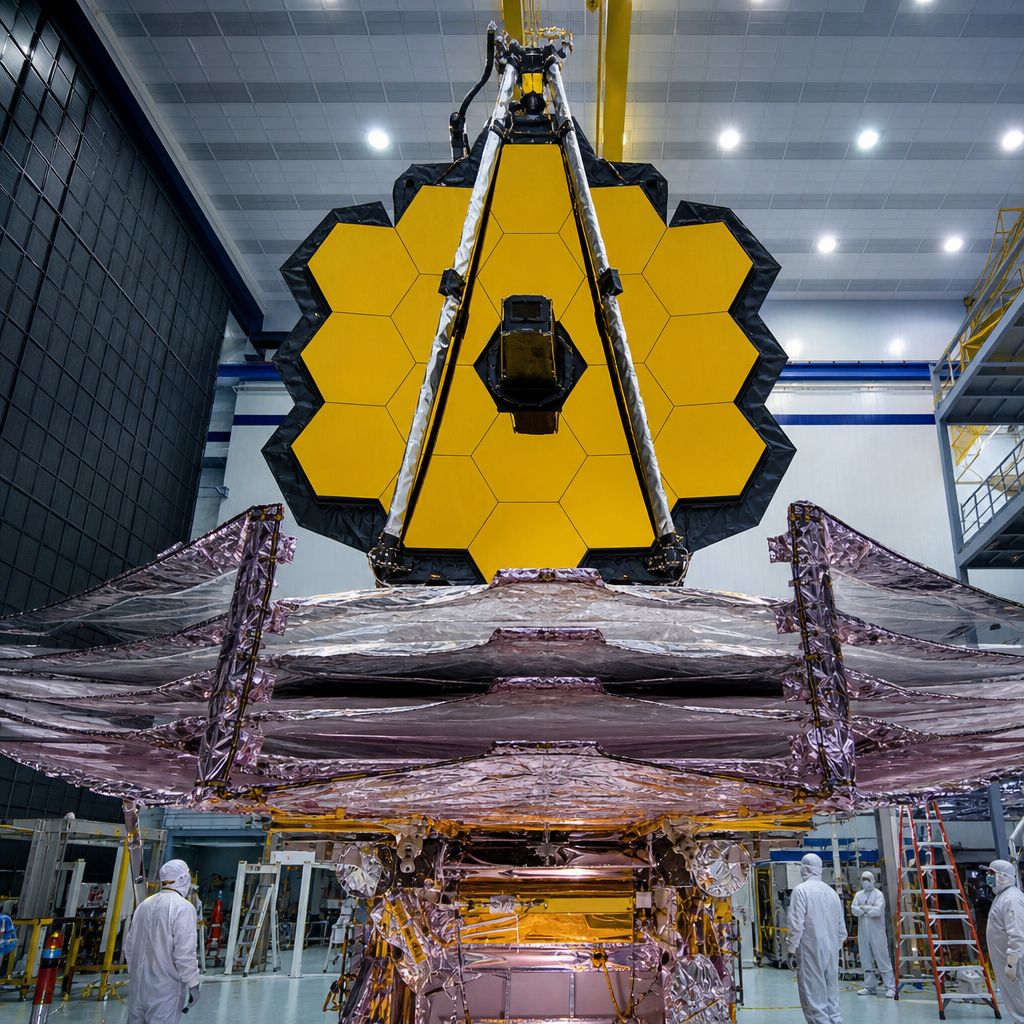
The James Webb Space Telescope is an infrared-optimized space observatory launched on December 25, 2021, from the Guiana Space Centre in French Guiana. Unlike its predecessor, the Hubble Space Telescope, which primarily operates in visible and ultraviolet wavelengths, the JWST is designed to observe the universe in the near-infrared and mid-infrared spectrum (0.6 to 28.5 micrometers). This capability allows it to peer through cosmic dust clouds and detect light from the earliest stars and galaxies, which has been redshifted due to the expansion of the universe. The telescope's primary mirror, composed of 18 hexagonal beryllium segments coated with gold, spans 6.5 meters in diameter, providing a collecting area approximately six times larger than Hubble's.
The JWST is positioned at the second Lagrange point (L2), located approximately 1.5 million kilometers from Earth, where gravitational forces and orbital motion balance to create a stable environment. This location minimizes thermal interference from Earth and the Moon, enabling the telescope to maintain its operational temperature of around 50 Kelvin (-223°C) through a combination of passive cooling and a five-layer sunshield. The sunshield, roughly the size of a tennis court, blocks solar radiation and dissipates heat, ensuring the instruments remain cold enough to detect faint infrared signals. The telescope's design incorporates four primary scientific instruments: the Near Infrared Camera (NIRCam), the Near Infrared Spectrograph (NIRSpec), the Mid-Infrared Instrument (MIRI), and the Fine Guidance Sensor/Near Infrared Imager and Slitless Spectrograph (FGS/NIRISS). Each instrument serves distinct observational purposes, from imaging to spectroscopy, enabling a comprehensive analysis of astronomical targets.
Technical Specifications
The JWST's technical specifications reflect its status as one of the most complex space observatories ever constructed. The primary mirror's 18 segments are individually adjustable via actuators, allowing for precise alignment and correction of optical aberrations. The mirror's gold coating enhances its reflectivity in the infrared spectrum, optimizing its performance for low-light observations. The telescope's sunshield, made of Kapton, a polyimide film, consists of five layers separated by vacuum gaps to minimize heat transfer. Each layer is coated with aluminum and doped silicon to reflect solar radiation effectively.
The scientific instruments aboard the JWST are equally sophisticated. NIRCam, developed by the University of Arizona and Lockheed Martin, serves as the telescope's primary imager, capable of capturing high-resolution images in the near-infrared range. NIRSpec, provided by ESA, is a multi-object spectrograph that can observe up to 100 objects simultaneously, enabling large-scale spectroscopic surveys. MIRI, a joint development by NASA and ESA, extends the telescope's capabilities into the mid-infrared range, requiring active cooling to 7 Kelvin (-266°C) via a cryocooler. FGS/NIRISS, contributed by CSA, combines a fine guidance sensor for precise pointing with a slitless spectrograph for exoplanet transit observations. These instruments collectively enable the JWST to address a wide range of scientific objectives, from studying the atmospheres of exoplanets to observing the formation of the first galaxies.
Scientific Objectives
The James Webb Space Telescope was conceived to address four primary scientific themes: the end of the cosmic "dark ages," the assembly of galaxies, the birth of stars and protoplanetary systems, and the origins of life. One of its most ambitious goals is to observe the first galaxies that formed in the early universe, approximately 13.5 billion years ago. By detecting the redshifted light from these primordial structures, the JWST can provide insights into the processes that governed galaxy formation and evolution. Additionally, the telescope is designed to study the interstellar medium, where stars and planetary systems are born, by penetrating the dense dust clouds that obscure these regions from visible-light observatories.
Another critical objective is the characterization of exoplanets, particularly those in the habitable zones of their host stars. The JWST's spectroscopic capabilities allow scientists to analyze the atmospheric composition of exoplanets, searching for biomarkers such as water vapor, methane, and carbon dioxide. This research could provide clues about the potential for life beyond Earth. Furthermore, the telescope is expected to contribute to our understanding of the solar system by observing planets, moons, and small bodies with unprecedented detail. For example, it can study the atmospheres of gas giants like Jupiter and Saturn, as well as the surface compositions of icy moons such as Europa and Enceladus.
Historical Development
The development of the James Webb Space Telescope spans over two decades, with its origins tracing back to the early 1990s. Initially conceived as the Next Generation Space Telescope (NGST), the project was renamed in 2002 to honor James E. Webb, NASA's second administrator, who played a pivotal role in the Apollo program. The JWST's design and construction involved contributions from thousands of scientists, engineers, and technicians across 14 countries, making it one of the most international space projects in history. Key milestones included the completion of the primary mirror in 2016, the integration of the sunshield in 2018, and the final assembly of the telescope in 2019.
The project faced numerous challenges, including technical delays, budget overruns, and the complexity of integrating its components. The telescope's launch was postponed multiple times due to issues such as sunshield tears, software glitches, and the COVID-19 pandemic. Despite these setbacks, the JWST was successfully launched aboard an Ariane 5 rocket, marking the culmination of years of meticulous planning and engineering. The deployment sequence, which included the unfolding of the sunshield and the alignment of the primary mirror segments, was executed flawlessly, demonstrating the robustness of the telescope's design.
Application Area
- Cosmology and Galaxy Formation: The JWST is instrumental in studying the early universe, particularly the formation and evolution of the first galaxies. By observing high-redshift objects, it provides data on the processes that shaped the cosmos during its infancy, such as reionization and the growth of supermassive black holes.
- Star and Planet Formation: The telescope's infrared capabilities allow it to peer into star-forming regions, revealing the mechanisms behind the birth of stars and planetary systems. It can detect protoplanetary disks and analyze their chemical compositions, shedding light on the conditions necessary for planet formation.
- Exoplanet Characterization: The JWST is equipped to study the atmospheres of exoplanets, particularly those in the habitable zones of their host stars. Its spectroscopic instruments can identify molecular signatures, such as water and carbon dioxide, which are critical for assessing the potential for life.
- Solar System Exploration: The telescope provides detailed observations of objects within our solar system, including planets, moons, and small bodies. It can analyze the atmospheres of gas giants, the surface compositions of icy moons, and the dynamics of comets and asteroids.
Well Known Examples
- First Deep Field Image: One of the JWST's earliest and most iconic images, released in July 2022, showcased the telescope's ability to capture deep-field observations of the universe. The image revealed thousands of galaxies, some of which formed just a few hundred million years after the Big Bang, providing unprecedented insights into the early cosmos.
- Exoplanet Atmosphere Analysis: In August 2022, the JWST detected carbon dioxide in the atmosphere of the exoplanet WASP-39b, a hot gas giant located approximately 700 light-years from Earth. This discovery marked the first definitive detection of carbon dioxide in an exoplanet's atmosphere, demonstrating the telescope's capability to characterize distant worlds.
- Star-Forming Region Observations: The telescope has captured detailed images of star-forming regions such as the Carina Nebula and the Tarantula Nebula. These observations have revealed previously hidden structures within these clouds, including protostars and their surrounding disks, advancing our understanding of stellar birth.
Risks and Challenges
- Technical Complexity: The JWST's intricate design, particularly its deployable sunshield and segmented mirror, posed significant engineering challenges. Any failure during deployment or alignment could have compromised the mission's success, as the telescope operates too far from Earth for manual repairs.
- Thermal Management: Maintaining the telescope's operational temperature is critical for its infrared observations. The sunshield must effectively block solar radiation, and the cryocooler for MIRI must function flawlessly to achieve the required cooling. Any thermal anomalies could degrade the instruments' performance.
- Data Transmission and Processing: The JWST generates vast amounts of data, which must be transmitted to Earth and processed by scientific teams. Ensuring the integrity and accessibility of this data requires robust communication systems and advanced computational resources.
- Long-Term Operational Risks: The telescope's remote location at L2 means it is beyond the reach of servicing missions, unlike the Hubble Space Telescope. Any mechanical or instrumental failures must be addressed through remote diagnostics and software solutions, limiting the scope of potential repairs.
Similar Terms
- Hubble Space Telescope: The Hubble Space Telescope, launched in 1990, is a visible and ultraviolet observatory that has revolutionized astronomy. While it shares some scientific goals with the JWST, such as galaxy formation and exoplanet studies, Hubble operates primarily in shorter wavelengths and lacks the infrared capabilities of the JWST.
- Spitzer Space Telescope: The Spitzer Space Telescope, launched in 2003, was NASA's premier infrared observatory before the JWST. Although it provided valuable data on star formation and exoplanets, its smaller mirror and limited wavelength range restricted its observational capabilities compared to the JWST.
- Chandra X-ray Observatory: The Chandra X-ray Observatory, launched in 1999, specializes in high-energy X-ray astronomy. While it complements the JWST by studying phenomena such as black holes and supernovae, its focus on X-rays distinguishes it from the JWST's infrared observations.
Summary
The James Webb Space Telescope represents a transformative advancement in space-based astronomy, offering unprecedented capabilities for observing the universe in the infrared spectrum. Its large primary mirror, advanced instrumentation, and strategic positioning at the second Lagrange point enable it to address fundamental questions about cosmic evolution, galaxy formation, and the origins of life. Despite the technical and operational challenges associated with its development and deployment, the JWST has already delivered groundbreaking discoveries, from the detection of carbon dioxide in exoplanet atmospheres to the imaging of the earliest galaxies. As it continues to operate, the telescope is expected to redefine our understanding of the universe and inspire future generations of astronomers and space scientists.
--