
Deutsch: Internationale Raumstation ISS / Español: Estación Espacial Internacional (EEI) / Português: Estação Espacial Internacional (EEI) / Français: Station spatiale internationale (ISS) / Italiano: Stazione Spaziale Internazionale (ISS)
The International Space Station ISS is a habitable artificial satellite in low Earth orbit, serving as a microgravity and space environment research laboratory. Operated by an international consortium of space agencies, it represents one of the most complex engineering projects in human history, facilitating scientific advancements across multiple disciplines. Its modular design and continuous human presence since 2000 enable long-duration experiments in biology, physics, astronomy, and materials science.
General Description
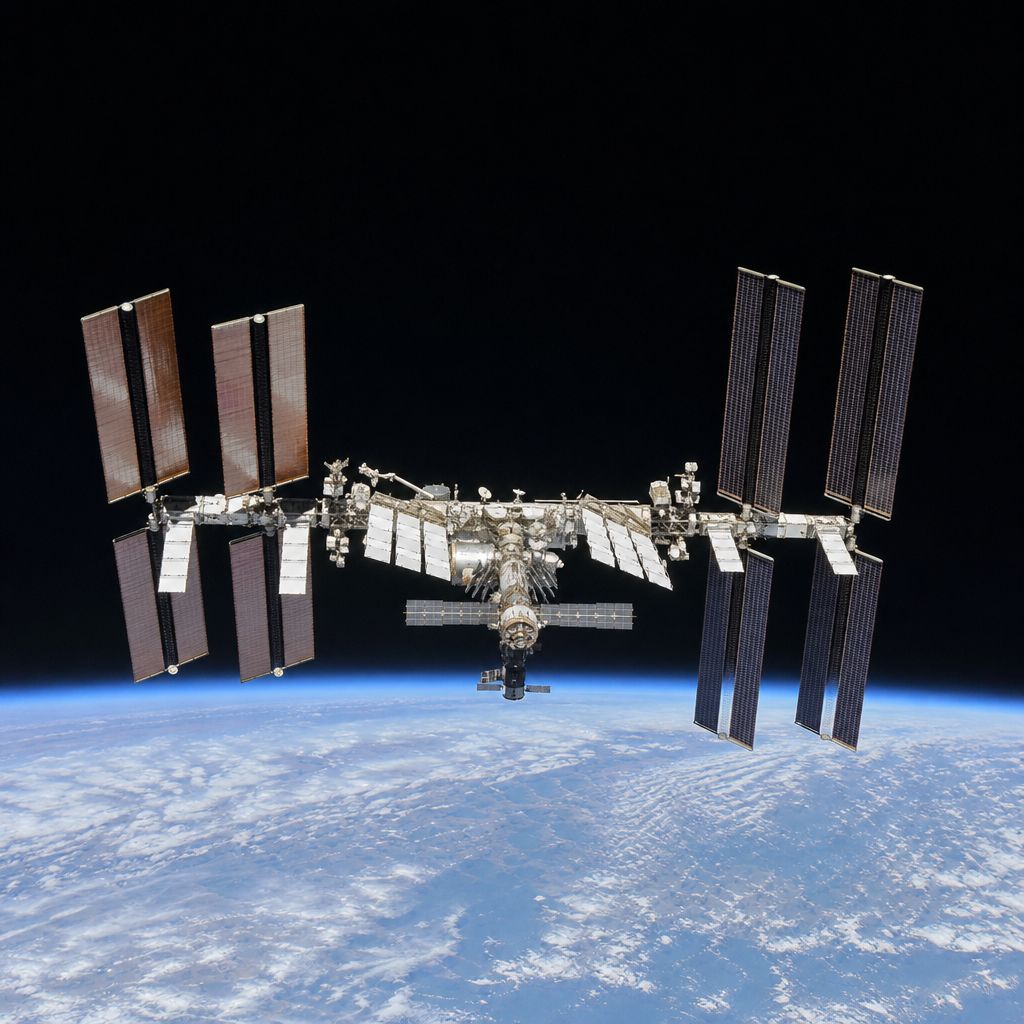
The International Space Station (ISS) is a collaborative program between five space agencies: NASA (United States), Roscosmos (Russia), JAXA (Japan), ESA (Europe), and CSA (Canada). Construction began in 1998 with the launch of the Russian Zarya module, followed by the U.S. Unity node. The station orbits Earth at an altitude of approximately 400 kilometers, completing one revolution every 90 minutes at a velocity of 28,000 kilometers per hour. Its pressurized modules provide a habitable volume of about 930 cubic meters, accommodating a crew of up to seven astronauts and cosmonauts for missions typically lasting six months.
The ISS operates as a zero-gravity laboratory, where researchers conduct experiments impossible to replicate on Earth. These include studies on human physiology in microgravity, fluid dynamics, combustion processes, and the behavior of materials in space. The station's external platforms, such as the Japanese Kibo module and the European Columbus laboratory, host experiments exposed to the vacuum of space. Power is generated by solar arrays spanning an area of 2,500 square meters, providing up to 120 kilowatts of electricity. Waste heat is dissipated via radiators, while life support systems recycle air and water to sustain the crew.
Technical Specifications
The ISS consists of 16 pressurized modules, including laboratories, living quarters, and docking ports. Key components include the U.S. Destiny laboratory, the European Columbus module, and the Japanese Kibo complex, which features an external experiment platform. The station's structure is maintained by a truss system measuring 109 meters in length, supporting solar arrays, radiators, and external payloads. The Canadarm2 robotic arm, developed by CSA, assists in assembly, maintenance, and cargo handling.
The station's orbit is inclined at 51.6 degrees to the equator, allowing coverage of 90% of Earth's inhabited regions. Altitude is periodically adjusted to counteract atmospheric drag, which gradually lowers the orbit. Propulsion is provided by the Russian Zvezda module and visiting spacecraft, such as the Progress resupply vehicle. Communication with ground control is maintained via NASA's Tracking and Data Relay Satellite System (TDRSS) and Russian Luch satellites, ensuring continuous data transmission at rates up to 300 megabits per second.
Historical Development
The concept of a permanent space station dates back to the 1980s, with NASA's Freedom program serving as a precursor. Following the end of the Cold War, the U.S. and Russia agreed to merge their space station efforts, leading to the ISS partnership in 1993. The first module, Zarya, was launched in November 1998, followed by the U.S. Unity node later that year. Continuous human occupation began in November 2000 with Expedition 1, marking the start of uninterrupted human presence in space.
Assembly was completed in 2011 with the installation of the final U.S. module, Leonardo. The station has since undergone upgrades, including the addition of the Bigelow Expandable Activity Module (BEAM) in 2016, a prototype for inflatable habitats. The ISS has hosted over 260 individuals from 20 countries, including commercial astronauts and space tourists. Its operational lifespan has been extended multiple times, with current plans to maintain the station until at least 2030, after which it may be deorbited or transitioned to commercial operations.
Scientific Research and Achievements
The ISS serves as a unique platform for research in microgravity, enabling discoveries with terrestrial and space applications. Studies in human physiology have revealed insights into muscle atrophy, bone density loss, and fluid redistribution in the absence of gravity, informing medical treatments for osteoporosis and cardiovascular diseases. The Alpha Magnetic Spectrometer (AMS-02), installed on the station's exterior, searches for dark matter and antimatter, contributing to particle physics research.
Fluid dynamics experiments on the ISS have improved understanding of capillary flow and heat transfer, benefiting industrial processes on Earth. Combustion studies in microgravity have led to cleaner-burning fuels and fire safety advancements. The station also supports Earth observation, monitoring climate change, natural disasters, and agricultural patterns. Educational outreach programs, such as the Amateur Radio on the ISS (ARISS) initiative, engage students worldwide in STEM fields.
Application Area
- Microgravity Research: The ISS provides a controlled environment for experiments in biology, physics, and materials science that cannot be conducted on Earth. This includes protein crystallization for drug development, semiconductor manufacturing, and fluid behavior studies.
- Technology Demonstration: New technologies, such as life support systems, robotics, and satellite servicing tools, are tested on the ISS before deployment in deep-space missions. Examples include the Robotic Refueling Mission (RRM) and the Cold Atom Lab (CAL).
- Earth Observation and Remote Sensing: The station's orbit allows for high-resolution imaging of Earth's surface, aiding in disaster response, environmental monitoring, and climate research. Instruments like the ECOsystem Spaceborne Thermal Radiometer Experiment on Space Station (ECOSTRESS) track plant health and water usage.
- International Collaboration: The ISS serves as a model for multinational cooperation in space exploration, fostering diplomatic and scientific partnerships. It has facilitated joint missions, such as the U.S.-Russian crew exchanges and European experiments in the Columbus module.
- Commercial Spaceflight: The ISS has become a hub for commercial activities, including private astronaut missions, in-space manufacturing, and payload hosting. Companies like SpaceX and Northrop Grumman provide cargo resupply services, while Axiom Space plans to attach commercial modules to the station.
Well Known Examples
- Alpha Magnetic Spectrometer (AMS-02): A particle physics experiment mounted on the ISS's exterior, designed to detect cosmic rays and search for dark matter. It has collected over 170 billion cosmic ray events since its installation in 2011 (Source: CERN).
- Veggie Plant Growth System: A facility for growing plants in microgravity, enabling research on food production for long-duration space missions. Astronauts have successfully cultivated lettuce, wheat, and zinnias, demonstrating the feasibility of space agriculture.
- Cold Atom Lab (CAL): A quantum physics experiment that creates ultra-cold atom clouds, approaching absolute zero. It allows scientists to study Bose-Einstein condensates, a state of matter with potential applications in quantum computing (Source: NASA).
- Canadarm2 and Dextre: Robotic systems developed by the Canadian Space Agency for assembly, maintenance, and cargo handling. Canadarm2, a 17-meter-long robotic arm, has been instrumental in installing modules and capturing visiting spacecraft.
- Bigelow Expandable Activity Module (BEAM): An inflatable habitat attached to the ISS in 2016, testing the viability of expandable structures for future space stations and lunar/Mars habitats. BEAM has demonstrated resistance to radiation and micrometeoroid impacts (Source: NASA).
Risks and Challenges
- Micrometeoroid and Orbital Debris (MMOD) Impact: The ISS is vulnerable to collisions with space debris, which can damage critical systems or penetrate pressurized modules. Shielding and avoidance maneuvers are employed to mitigate this risk, but the growing debris population in low Earth orbit remains a concern (Source: ESA Space Debris Office).
- Radiation Exposure: Astronauts on the ISS are exposed to higher levels of cosmic radiation than on Earth, increasing the risk of cancer and other health issues. Shielding and operational protocols, such as limiting spacewalks during solar particle events, are used to reduce exposure.
- System Failures and Maintenance: The station's aging infrastructure requires continuous maintenance and upgrades. Failures in life support systems, power generation, or thermal control could jeopardize crew safety. Redundant systems and spare parts are maintained to address such contingencies.
- Logistical Challenges: Resupplying the ISS with food, water, and equipment depends on regular cargo missions. Delays or failures in launch vehicles, such as the 2015 Progress M-27M and 2014 Cygnus Orb-3 incidents, can disrupt operations and strain onboard resources.
- Geopolitical Tensions: The ISS partnership has historically transcended political conflicts, but geopolitical tensions, such as those arising from the 2022 Russian invasion of Ukraine, have raised concerns about the station's future. Collaborative agreements and contingency plans are in place to ensure continuity.
- End-of-Life Disposal: The ISS will eventually be decommissioned, requiring a controlled deorbit to ensure debris does not pose a hazard to populated areas. NASA and its partners are developing plans to safely guide the station into the Pacific Ocean, a process expected to cost hundreds of millions of dollars (Source: NASA Office of Inspector General).
Similar Terms
- Skylab: The United States' first space station, launched in 1973 and operated until 1979. Skylab hosted three crewed missions and conducted solar observations, Earth resources studies, and microgravity experiments. Unlike the ISS, it was not designed for long-term habitation or international collaboration.
- Mir: A Soviet (later Russian) space station launched in 1986 and deorbited in 2001. Mir was the first modular space station and held the record for the longest continuous human presence in space (3,644 days) until surpassed by the ISS. It served as a testbed for long-duration missions and international cooperation, including the Shuttle-Mir program.
- Tiangong Space Station: China's modular space station, launched in 2021 and fully operational by 2022. Tiangong is smaller than the ISS, with a pressurized volume of 110 cubic meters, and is designed for a crew of three. It represents China's independent human spaceflight capabilities and hosts experiments in microgravity and space medicine.
- Lunar Gateway: A planned space station in lunar orbit, developed by NASA and international partners as part of the Artemis program. The Gateway will serve as a staging point for crewed lunar landings and deep-space missions, featuring habitats, power systems, and docking ports for visiting spacecraft. Unlike the ISS, it will operate in a highly elliptical orbit around the Moon.
Weblinks
- top500.de: 'International Space Station' in the glossary of the top500.de
Summary
The International Space Station ISS is a landmark achievement in space exploration, enabling groundbreaking research in microgravity, fostering international collaboration, and advancing technology for future missions. Its modular design, continuous human presence, and diverse scientific payloads have yielded insights into human health, materials science, and fundamental physics. While facing challenges such as space debris, radiation, and geopolitical uncertainties, the ISS remains a critical platform for preparing humanity for deep-space exploration. As commercial activities expand and partnerships evolve, the station's legacy will extend beyond its operational lifespan, shaping the future of space habitation and research.
--
Related Articles to the term 'International Space Station' | |
| 'SkyLab' | ■■■■■■■■■ |
| SkyLab was the United States\' first space station, launched and operated by NASA in the 1970s. It was . . . Read More | |
| 'Scientific Research' at maritime-glossary.com | ■■■■■■■■■ |
| Scientific Research in the maritime context refers to the systematic study and exploration of the ocean . . . Read More | |
| 'SpaceLab' | ■■■■■■■■■ |
| SpaceLab was a program developed by the European Space Agency (ESA) in the 1980s and 1990s to promote . . . Read More | |
| 'LEO' | ■■■■■■■■ |
| LEO stands for Low Earth Orbit. Low Earth Orbit refers to an altitude range of around 100-2000 kilometers . . . Read More | |
| 'Marine research' at maritime-glossary.com | ■■■■■■■■ |
| Marine research in the Maritime context refers to the systematic study of the Ocean, its ecosystems, . . . Read More | |
| 'Orbiter' | ■■■■■■■ |
| Orbiter: An \'orbiter\' in the aerospace context refers to a spacecraft or vehicle that is designed to . . . Read More | |
| 'Weightlessness' | ■■■■■■■ |
| Weightlessness: In the aerospace context, weightlessness, also known as microgravity, refers to the state . . . Read More | |
| 'Period' | ■■■■■■■ |
| Period: In the aerospace context, a period refers to a measurement of time or the duration of a repeating . . . Read More | |
| 'Shuttle' | ■■■■■■■ |
| A shuttle is a spacecraft that is designed to transport people, cargo, or both between Earth and a space . . . Read More | |
| 'Research' at maritime-glossary.com | ■■■■■■■ |
| Research in the maritime context refers to the systematic investigation into and study of materials, . . . Read More | |
Do you have more interesting information, examples? Send us a new or updated description !
If you sent more than 600 words, which we can publish, we will -if you allow us - sign your article with your name!