
Deutsch: SpaceX Dragon / Español: SpaceX Dragon / Português: SpaceX Dragon / Français: SpaceX Dragon / Italiano: SpaceX Dragon
The SpaceX Dragon is a reusable spacecraft developed by Space Exploration Technologies Corp. (SpaceX) to transport cargo and crew to the International Space Station (ISS) and other low Earth orbit (LEO) destinations. Designed as part of NASA's Commercial Orbital Transportation Services (COTS) program, it represents a pivotal advancement in commercial spaceflight, combining cost efficiency with versatility for both government and private sector missions.
General Description
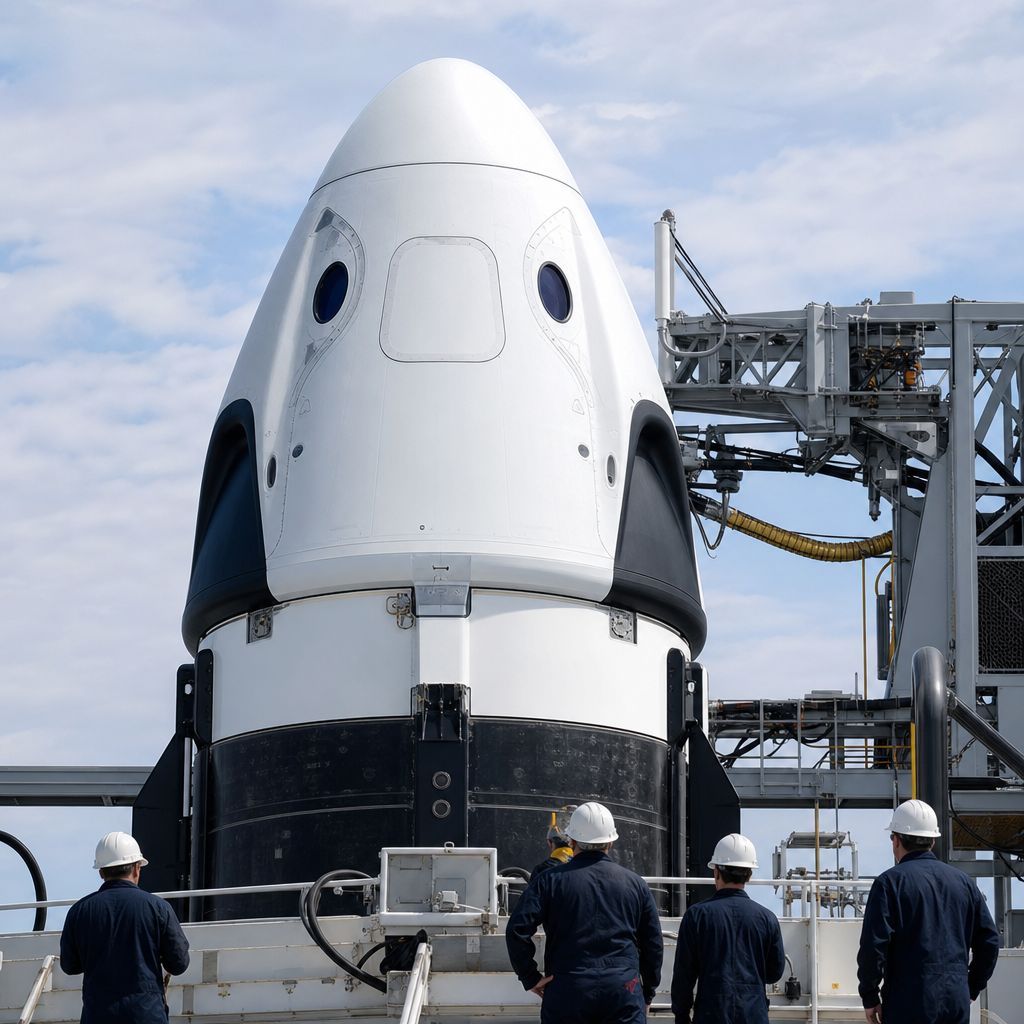
The SpaceX Dragon is a free-flying, capsule-based spacecraft engineered to perform two primary functions: cargo resupply and crew transportation. Its design adheres to the principles of reusability, a cornerstone of SpaceX's mission to reduce the cost of space access. The spacecraft consists of two main components: the pressurized capsule, which houses crew or cargo, and the unpressurized trunk, which carries additional payloads and supports the spacecraft's solar arrays. The Dragon's heat shield, derived from NASA's Apollo program and upgraded with SpaceX's proprietary PICA-X (Phenolic Impregnated Carbon Ablator) material, enables safe re-entry into Earth's atmosphere at velocities exceeding 7.8 kilometers per second.
The spacecraft is launched atop SpaceX's Falcon 9 rocket, a two-stage launch vehicle powered by Merlin engines burning a combination of rocket-grade kerosene (RP-1) and liquid oxygen (LOX). The Dragon's propulsion system includes 18 Draco thrusters for orbital maneuvering and attitude control, as well as SuperDraco engines—originally developed for the Crew Dragon variant—which serve as a launch abort system. This dual-purpose design enhances crew safety by enabling rapid separation from the launch vehicle in the event of an emergency. The Dragon's avionics and software are designed for autonomous operation, though manual override capabilities are retained for crewed missions, ensuring redundancy and operational flexibility.
The spacecraft's modular architecture allows for rapid adaptation to mission-specific requirements. For cargo missions, the Dragon can carry up to 6,000 kilograms of pressurized and unpressurized payloads to the ISS, while the Crew Dragon variant accommodates up to seven astronauts. The trunk section, jettisoned prior to re-entry, provides additional volume for external payloads, such as scientific instruments or satellite deployers. Upon completion of its mission, the Dragon performs a deorbit burn, re-enters the atmosphere, and splashes down in the Pacific or Atlantic Ocean, where it is recovered by SpaceX vessels for refurbishment and reuse.
Technical Specifications
The Dragon spacecraft's technical parameters reflect its dual-role capability. The pressurized capsule has an internal volume of 10 cubic meters, while the trunk adds an additional 14 cubic meters for unpressurized cargo. The combined mass of the spacecraft at launch varies depending on the mission profile, with a maximum launch mass of approximately 12,000 kilograms. The Draco thrusters, each generating 400 newtons of thrust, enable precise orbital adjustments, while the SuperDraco engines produce up to 73 kilonewtons of thrust for launch abort scenarios. The spacecraft's power is supplied by two deployable solar arrays mounted on the trunk, which generate up to 5 kilowatts of electricity.
The Dragon's thermal protection system (TPS) is a critical component for re-entry. The PICA-X heat shield, with a diameter of 3.6 meters, is capable of withstanding temperatures exceeding 1,600 degrees Celsius during atmospheric re-entry. The spacecraft's structure is primarily composed of aluminum-lithium alloys, chosen for their high strength-to-weight ratio and corrosion resistance. For crewed missions, the Dragon is equipped with a life support system that regulates cabin pressure, temperature, and humidity, while also scrubbing carbon dioxide from the atmosphere. The spacecraft's communication systems include S-band and Ku-band transponders, enabling data transmission and telemetry relay to ground stations and NASA's Tracking and Data Relay Satellite System (TDRSS).
Historical Development
The development of the SpaceX Dragon began in 2004, following SpaceX's selection as one of two companies (alongside Rocketplane Kistler) for NASA's COTS program. The program aimed to foster commercial resupply services to the ISS after the retirement of the Space Shuttle. The Dragon's first successful test flight, COTS Demo Flight 1, occurred on December 8, 2010, marking the first time a privately developed spacecraft was recovered from orbit. This milestone was followed by COTS Demo Flight 2 in May 2012, during which the Dragon became the first commercial spacecraft to rendezvous and berth with the ISS, delivering 520 kilograms of cargo.
The success of these missions led to the initiation of SpaceX's Commercial Resupply Services (CRS) contract with NASA, under which the Dragon conducted its first operational cargo mission (CRS-1) in October 2012. Over the next decade, the Dragon completed 20 CRS missions, delivering over 43,000 kilograms of cargo to the ISS and returning approximately 33,000 kilograms of scientific samples and equipment to Earth. The Crew Dragon variant, developed under NASA's Commercial Crew Program (CCP), achieved its first crewed flight (Demo-2) on May 30, 2020, carrying NASA astronauts Douglas Hurley and Robert Behnken to the ISS. This mission marked the first crewed orbital launch from U.S. soil since the Space Shuttle's retirement in 2011.
Application Area
- International Space Station Resupply: The Dragon spacecraft is a cornerstone of NASA's logistics infrastructure for the ISS, delivering critical supplies such as food, scientific experiments, and replacement hardware. Its ability to return cargo to Earth distinguishes it from other resupply vehicles, such as the Russian Progress or the European Automated Transfer Vehicle (ATV), which are designed for single-use disposal.
- Crew Transportation: The Crew Dragon variant enables NASA to transport astronauts to and from the ISS, reducing reliance on Russia's Soyuz spacecraft. This capability is essential for maintaining a continuous human presence on the ISS and supporting long-duration scientific research in microgravity.
- Commercial and Scientific Missions: Beyond government contracts, the Dragon has been utilized for commercial missions, including the deployment of small satellites and the transport of private payloads. For example, the Dragon has carried experiments for pharmaceutical companies, materials science research, and biological studies, leveraging its pressurized and unpressurized cargo capacity.
- Technology Demonstration: The Dragon serves as a testbed for emerging technologies, such as in-space manufacturing and advanced life support systems. Its reusability also provides valuable data for SpaceX's Starship program, which aims to further reduce the cost of space access through fully reusable launch systems.
Well Known Examples
- CRS-1 Mission (2012): The first operational cargo resupply mission under NASA's CRS contract, CRS-1 delivered 400 kilograms of supplies to the ISS, including scientific experiments and crew provisions. Despite a secondary payload failure (the loss of an Orbcomm satellite due to a Falcon 9 engine anomaly), the Dragon successfully completed its primary mission, demonstrating the viability of commercial resupply services.
- Demo-2 Mission (2020): The first crewed flight of the Crew Dragon, Demo-2, carried NASA astronauts Douglas Hurley and Robert Behnken to the ISS, marking a historic milestone in commercial spaceflight. The mission validated the spacecraft's crewed capabilities, including its launch abort system, life support systems, and autonomous docking procedures.
- Inspiration4 Mission (2021): The first all-civilian orbital spaceflight, Inspiration4, utilized a Crew Dragon spacecraft to carry four private citizens on a three-day mission in LEO. The mission, funded by entrepreneur Jared Isaacman, demonstrated the potential for commercial human spaceflight beyond government-sponsored programs and included scientific research conducted in collaboration with institutions such as the Translational Research Institute for Space Health (TRISH).
- CRS-22 Mission (2021): This mission delivered the first pair of new solar arrays (iROSA) to the ISS, part of NASA's effort to upgrade the station's power generation capabilities. The Dragon's unpressurized trunk carried the 340-kilogram arrays, which were later installed by astronauts during extravehicular activities (EVAs).
Risks and Challenges
- Launch and Re-Entry Hazards: The Dragon's reliance on the Falcon 9 rocket introduces risks associated with launch failures, such as engine malfunctions or structural anomalies. While the Crew Dragon's launch abort system mitigates some of these risks, the potential for catastrophic failure remains a critical concern, particularly for crewed missions. Re-entry poses additional challenges, including the risk of heat shield degradation or parachute failure, which could compromise the spacecraft's integrity during splashdown.
- Space Debris and Micrometeoroid Impacts: Operating in LEO exposes the Dragon to the risk of collisions with space debris or micrometeoroids, which can damage critical systems such as solar arrays or thermal protection tiles. While the spacecraft's structure is designed to withstand minor impacts, a high-velocity collision could result in catastrophic failure, particularly during long-duration missions.
- Life Support System Reliability: For crewed missions, the Dragon's life support systems must maintain a stable environment for astronauts, including temperature, pressure, and atmospheric composition. Failures in these systems, such as carbon dioxide scrubber malfunctions or oxygen leaks, could pose immediate risks to crew health and mission success. Redundancy and fail-safe mechanisms are essential to mitigate these risks, but they add complexity and mass to the spacecraft.
- Refurbishment and Reusability: While reusability is a key advantage of the Dragon, the process of refurbishing the spacecraft between missions introduces challenges, including wear and tear on critical components, such as the heat shield and parachutes. Ensuring the reliability of reused hardware requires rigorous testing and inspection protocols, which can increase turnaround times and operational costs. SpaceX has addressed some of these challenges through iterative design improvements, such as upgrading the heat shield material and enhancing parachute systems.
- Regulatory and Safety Compliance: As a commercial spacecraft, the Dragon must adhere to stringent regulatory requirements set by agencies such as NASA and the Federal Aviation Administration (FAA). Compliance with these standards, particularly for crewed missions, involves extensive testing, certification, and ongoing oversight. Delays or failures in meeting these requirements can result in mission postponements or grounding, as seen during the Crew Dragon's development phase.
Similar Terms
- Cargo Dragon vs. Crew Dragon: The Cargo Dragon and Crew Dragon are variants of the same spacecraft, optimized for different mission profiles. The Cargo Dragon lacks the SuperDraco launch abort system, life support systems, and crew accommodations found in the Crew Dragon. However, both variants share a common design heritage, including the pressurized capsule and unpressurized trunk.
- SpaceX Starship: The Starship is SpaceX's next-generation spacecraft, designed for missions beyond LEO, including lunar and Martian exploration. Unlike the Dragon, which is optimized for LEO operations, the Starship is intended to be fully reusable and capable of carrying larger payloads and more crew members. While the Dragon remains a critical component of SpaceX's current operations, the Starship represents the company's long-term vision for interplanetary travel.
- Boeing CST-100 Starliner: The CST-100 Starliner is a crewed spacecraft developed by Boeing under NASA's Commercial Crew Program. Like the Crew Dragon, it is designed to transport astronauts to the ISS, but it utilizes a different design philosophy, including a weldless structure and a land-based landing system. The Starliner has faced developmental challenges, including software anomalies and propulsion system issues, which have delayed its operational deployment.
- Northrop Grumman Cygnus: The Cygnus is an expendable cargo spacecraft developed by Northrop Grumman for NASA's CRS program. Unlike the Dragon, the Cygnus is designed for single-use missions and burns up upon re-entry into Earth's atmosphere. It is launched atop the Antares rocket or the Atlas V and is primarily used for delivering pressurized cargo to the ISS.
Summary
The SpaceX Dragon is a versatile and reusable spacecraft that has revolutionized commercial spaceflight by providing reliable cargo and crew transportation to the ISS and other LEO destinations. Its modular design, advanced propulsion systems, and reusability have set new standards for cost efficiency and operational flexibility in the space industry. The Dragon's success in both cargo resupply and crewed missions has demonstrated the viability of public-private partnerships in space exploration, while its role in technology demonstration and commercial missions underscores its broader impact on the future of space access. Despite challenges related to launch risks, space debris, and life support reliability, the Dragon remains a critical asset for NASA and the global space community, with ongoing developments poised to expand its capabilities further.
--