
Deutsch: Marserkundung / Español: Exploración de Marte / Português: Exploração de Marte / Français: Exploration de Mars / Italiano: Esplorazione di Marte
Mars Exploration refers to the systematic study and investigation of the planet Mars through robotic spacecraft, landers, rovers, and orbiters, as well as the preparation for potential human missions. As the most Earth-like planet in the solar system, Mars has been a primary target for scientific research aimed at understanding planetary formation, the potential for past or present life, and the feasibility of future human colonization. Advances in propulsion, robotics, and life-support systems have enabled increasingly sophisticated missions, though the challenges of interplanetary travel and the Martian environment remain significant.
General Description
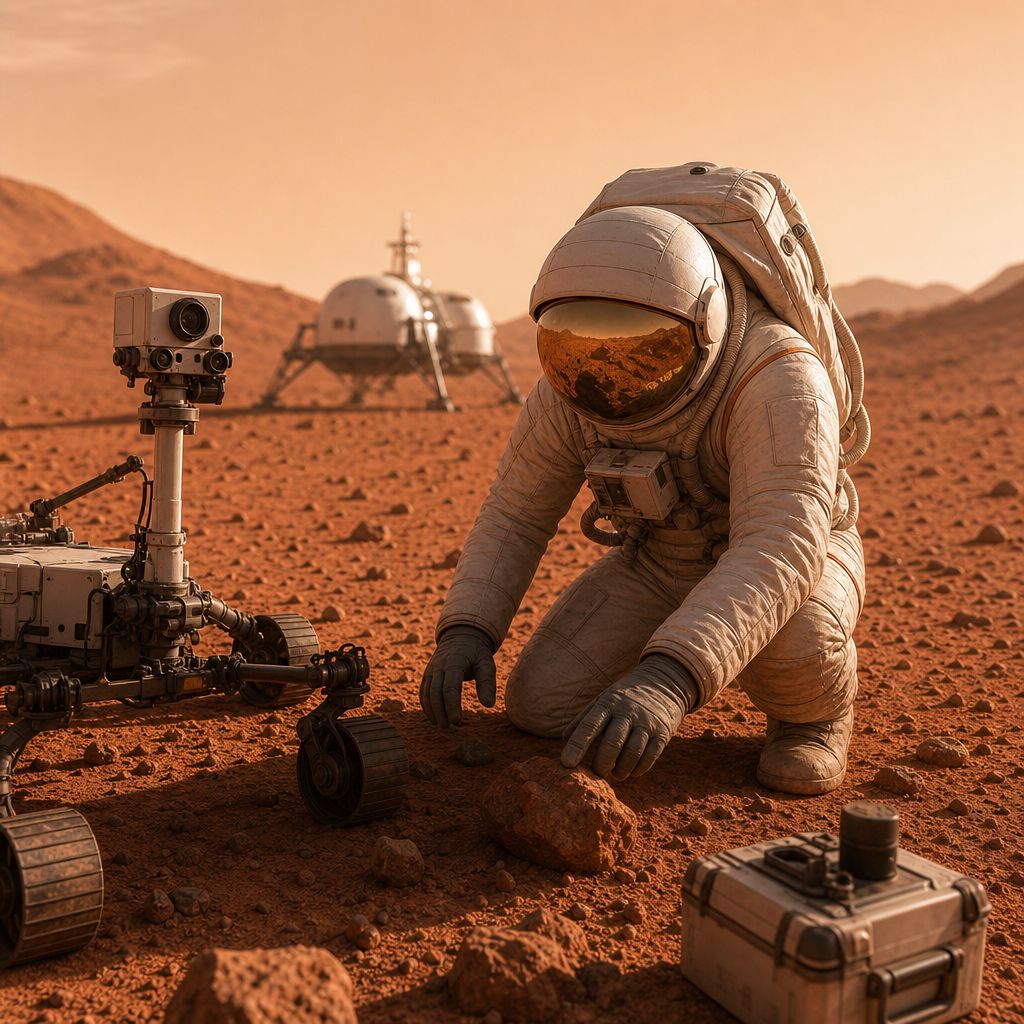
Mars Exploration encompasses a broad range of scientific, engineering, and exploratory activities designed to gather data about Mars' geology, atmosphere, climate history, and potential habitability. The primary objectives include searching for signs of past or present microbial life, characterizing the planet's surface and subsurface, and assessing its resources to support future human missions. Missions typically involve multiple phases: launch, interplanetary transit, entry, descent, and landing (EDL), followed by surface operations or orbital observations. The distance between Earth and Mars—ranging from approximately 54.6 million kilometers at closest approach to 401 million kilometers at opposition—poses significant communication delays, necessitating autonomous systems for real-time decision-making.
The technological foundation of Mars Exploration relies on propulsion systems capable of delivering payloads across interplanetary distances, such as chemical rockets, ion thrusters, or nuclear propulsion (the latter still in development). Robotic explorers, including rovers like NASA's Perseverance and China's Zhurong, are equipped with scientific instruments such as spectrometers, drills, and cameras to analyze soil, rock, and atmospheric samples. Orbiters, such as NASA's Mars Reconnaissance Orbiter (MRO) and ESA's Trace Gas Orbiter, provide high-resolution imaging, atmospheric data, and relay communications for surface missions. Human exploration, though not yet realized, is a long-term goal, with agencies like NASA and SpaceX developing architectures for crewed missions, including habitat modules, in-situ resource utilization (ISRU), and radiation shielding.
Historical Development
The history of Mars Exploration dates back to the early 1960s, with the first attempts by the Soviet Union's Mars 1 (1962), which failed en route. The first successful flyby was achieved by NASA's Mariner 4 in 1965, which returned the first close-up images of the Martian surface, revealing a cratered, Moon-like terrain. Subsequent missions, such as Mariner 9 (1971), became the first spacecraft to orbit Mars, mapping 100% of its surface and discovering volcanoes, canyons, and evidence of past water activity. The Viking program (1976) marked the first successful landings, with two orbiters and two landers conducting biological experiments to search for life—results that remain inconclusive but provided critical data on Martian soil chemistry.
The 1990s and 2000s saw a resurgence in Mars Exploration, driven by improved technology and international collaboration. NASA's Pathfinder mission (1997) deployed the first successful rover, Sojourner, demonstrating the feasibility of mobile exploration. The 2000s introduced a new generation of rovers, including Spirit and Opportunity (2004), which confirmed the past presence of liquid water through the discovery of hematite and sulfate minerals. The Curiosity rover (2012) expanded these findings by identifying organic molecules and seasonal methane variations, suggesting possible geological or biological activity. Recent missions, such as Perseverance (2021), focus on astrobiology, caching samples for future return to Earth, and testing technologies like the Ingenuity helicopter, the first aircraft to fly on another planet.
Technical Challenges
Mars Exploration presents unique technical challenges due to the planet's distance, thin atmosphere (composed of 95% carbon dioxide with a surface pressure of ~610 pascals), extreme temperatures (ranging from -125°C to 20°C), and high radiation levels. Entry, descent, and landing (EDL) are particularly complex, as the thin atmosphere provides limited aerodynamic braking, requiring heat shields, parachutes, and retro-rockets for safe touchdown. The "seven minutes of terror"—a term coined for the EDL phase of the Curiosity rover—illustrates the high-risk nature of these operations, where communication delays (3–22 minutes one-way) preclude real-time intervention from Earth.
Power systems for surface missions must contend with dust storms that can obscure solar panels, as experienced by the Opportunity rover, which lost contact after a global dust storm in 2018. Nuclear-powered systems, such as the Multi-Mission Radioisotope Thermoelectric Generator (MMRTG) used by Curiosity and Perseverance, provide a more reliable alternative but pose regulatory and safety challenges. Communication with Earth relies on a network of orbiters acting as relays, with data rates limited by distance and bandwidth constraints. For human missions, additional challenges include life support, psychological stress, and the need for closed-loop systems to recycle air, water, and waste. Radiation exposure during the transit and on the surface remains a critical concern, with galactic cosmic rays and solar particle events posing risks to crew health (see NASA's Space Radiation Analysis Group guidelines).
Scientific Objectives
The scientific goals of Mars Exploration are organized around four key themes: determining whether life ever existed on Mars, characterizing the planet's climate and geology, preparing for human exploration, and advancing fundamental planetary science. The search for life focuses on identifying biosignatures—chemical, mineralogical, or morphological indicators of past or present biological activity. Missions like Perseverance target Jezero Crater, a former lakebed with delta deposits rich in clays and carbonates, which may preserve organic matter. Climate studies aim to reconstruct Mars' ancient environment, which is believed to have been warmer and wetter, with a thicker atmosphere capable of supporting liquid water. Geological investigations examine the planet's volcanic history, tectonic activity, and the role of water in shaping its surface, including features like Valles Marineris, the largest canyon system in the solar system.
Preparation for human exploration involves assessing hazards such as dust, radiation, and resource availability. The Mars Oxygen In-Situ Resource Utilization Experiment (MOXIE) aboard Perseverance demonstrated the production of oxygen from Martian CO₂, a critical step for future life-support systems and rocket propellant. Fundamental planetary science seeks to understand Mars' formation and evolution, including its core dynamics, magnetic field history, and the loss of its atmosphere, which is studied by missions like NASA's MAVEN (Mars Atmosphere and Volatile Evolution). Comparative planetology—comparing Mars to Earth and Venus—provides insights into the habitability of terrestrial planets and the potential for life beyond Earth.
Application Area
- Planetary Science: Mars Exploration advances our understanding of planetary formation, atmospheric evolution, and the potential for life in the universe. Data from missions inform models of solar system dynamics and the conditions necessary for habitability.
- Astrobiology: By studying Mars' past and present environments, scientists assess the likelihood of extraterrestrial life and refine strategies for detecting biosignatures on other planets, including exoplanets.
- Human Spaceflight: Robotic missions serve as precursors for crewed exploration, testing technologies for landing, habitat construction, and in-situ resource utilization. Lessons learned from Mars Exploration also apply to lunar missions and deep-space travel.
- Technology Development: The demands of Mars missions drive innovation in robotics, autonomous systems, propulsion, and life-support technologies, with spin-off applications in medicine, energy, and manufacturing on Earth.
- International Collaboration: Mars Exploration fosters cooperation among space agencies, including NASA, ESA, Roscosmos, CNSA, and private companies like SpaceX, promoting shared scientific goals and reducing mission costs.
Well Known Examples
- Viking Program (1976): NASA's first successful Mars landers, Viking 1 and Viking 2, conducted biological experiments and returned the first high-resolution images of the Martian surface. Though inconclusive, their findings shaped subsequent astrobiology research.
- Mars Pathfinder and Sojourner (1997): This mission demonstrated the feasibility of low-cost, rapid-deployment rovers, paving the way for future mobile explorers. Sojourner analyzed rocks and soil, confirming the presence of water-altered minerals.
- Mars Exploration Rovers (2004): Spirit and Opportunity operated for over a decade, covering tens of kilometers and providing evidence of past water activity through the discovery of hematite and sulfate deposits. Opportunity holds the record for the longest operational lifespan of a Mars rover (14 years).
- Mars Science Laboratory (2012): The Curiosity rover, equipped with a suite of advanced instruments, identified organic molecules, seasonal methane variations, and ancient lakebeds in Gale Crater, suggesting a habitable environment billions of years ago.
- Perseverance Rover and Ingenuity Helicopter (2021): Perseverance is the first mission to cache Martian samples for future return to Earth, while Ingenuity proved powered flight is possible in Mars' thin atmosphere, completing over 50 flights as of 2023.
- Mars Reconnaissance Orbiter (2006): This orbiter has provided unprecedented high-resolution imaging of Mars' surface, identifying landing sites, tracking seasonal changes, and studying atmospheric phenomena like dust storms.
Risks and Challenges
- Mission Failure: The complexity of Mars missions results in a high failure rate, with approximately 50% of all attempts ending in loss. Failures can occur during launch, transit, EDL, or surface operations, often due to technical malfunctions or human error.
- Communication Delays: The time lag for signals between Earth and Mars (3–22 minutes) necessitates autonomous systems for critical operations, increasing the risk of unanticipated errors. Loss of communication, as experienced by Spirit and Opportunity, can terminate missions prematurely.
- Dust and Environmental Hazards: Martian dust storms can obscure solar panels, reducing power generation, while abrasive dust particles may damage mechanical components. Extreme temperatures and low atmospheric pressure also pose risks to equipment and future human explorers.
- Radiation Exposure: Mars lacks a global magnetic field and has a thin atmosphere, exposing the surface to high levels of cosmic and solar radiation. This poses long-term health risks for human crews and may degrade electronic components over time.
- Planetary Protection: International agreements, such as the Outer Space Treaty (1967) and COSPAR guidelines, mandate the sterilization of spacecraft to prevent forward contamination of Mars with Earth microbes. Reverse contamination—bringing Martian samples to Earth—also requires stringent containment protocols to avoid potential biohazards.
- Cost and Funding: Mars missions are expensive, with costs ranging from hundreds of millions to billions of USD. Budget constraints and shifting political priorities can delay or cancel programs, as seen with NASA's Mars Sample Return mission, which faces funding uncertainties.
- Technological Limitations: Current propulsion systems limit transit times to 6–9 months, exposing crews to prolonged microgravity and radiation. Advances in nuclear propulsion or other technologies are needed to reduce travel time and improve mission safety.
Similar Terms
- Lunar Exploration: The study and investigation of the Moon, often serving as a testing ground for technologies and strategies applicable to Mars missions. Unlike Mars, the Moon lacks an atmosphere and has a shorter communication delay (1.3 seconds), but shares challenges like dust and radiation.
- Astrobiology: The interdisciplinary field focused on the origin, evolution, and distribution of life in the universe. Mars Exploration is a key component of astrobiology, as Mars is considered one of the most likely candidates for past or present extraterrestrial life.
- Planetary Protection: Policies and practices designed to prevent biological contamination of celestial bodies and protect Earth from potential extraterrestrial biohazards. Mars Exploration must adhere to strict planetary protection protocols to preserve scientific integrity.
- In-Situ Resource Utilization (ISRU): The practice of extracting and using local resources (e.g., water, CO₂) to support human missions. ISRU is critical for Mars Exploration, as it reduces the need to transport supplies from Earth, lowering mission costs and risks.
Summary
Mars Exploration represents one of the most ambitious and scientifically rewarding endeavors in space exploration, driven by the quest to understand the planet's past habitability, geological history, and potential for future human settlement. Robotic missions have revolutionized our knowledge of Mars, revealing evidence of ancient water, organic molecules, and dynamic atmospheric processes, while also demonstrating the feasibility of advanced technologies like autonomous rovers and powered flight. However, significant challenges remain, including the risks of mission failure, communication delays, environmental hazards, and the technical and financial demands of human exploration. As international collaboration and private sector involvement grow, Mars Exploration will continue to push the boundaries of science and engineering, offering insights into the origins of life and the future of humanity as a multi-planetary species.
--