
Deutsch: Spekulative Fiktion / Español: Ficción especulativa / Português: Ficção especulativa / Français: Fiction spéculative / Italiano: Fantascienza speculativa
Speculative Fiction is a broad literary and creative genre that explores hypothetical scenarios, often extrapolating from scientific, technological, or societal developments. Within the space industry, it serves as a critical tool for envisioning future possibilities, testing conceptual frameworks, and inspiring innovation. Unlike hard science fiction, which prioritizes scientific accuracy, speculative fiction embraces imaginative leaps to examine ethical, political, and existential questions arising from space exploration and colonization.
General Description
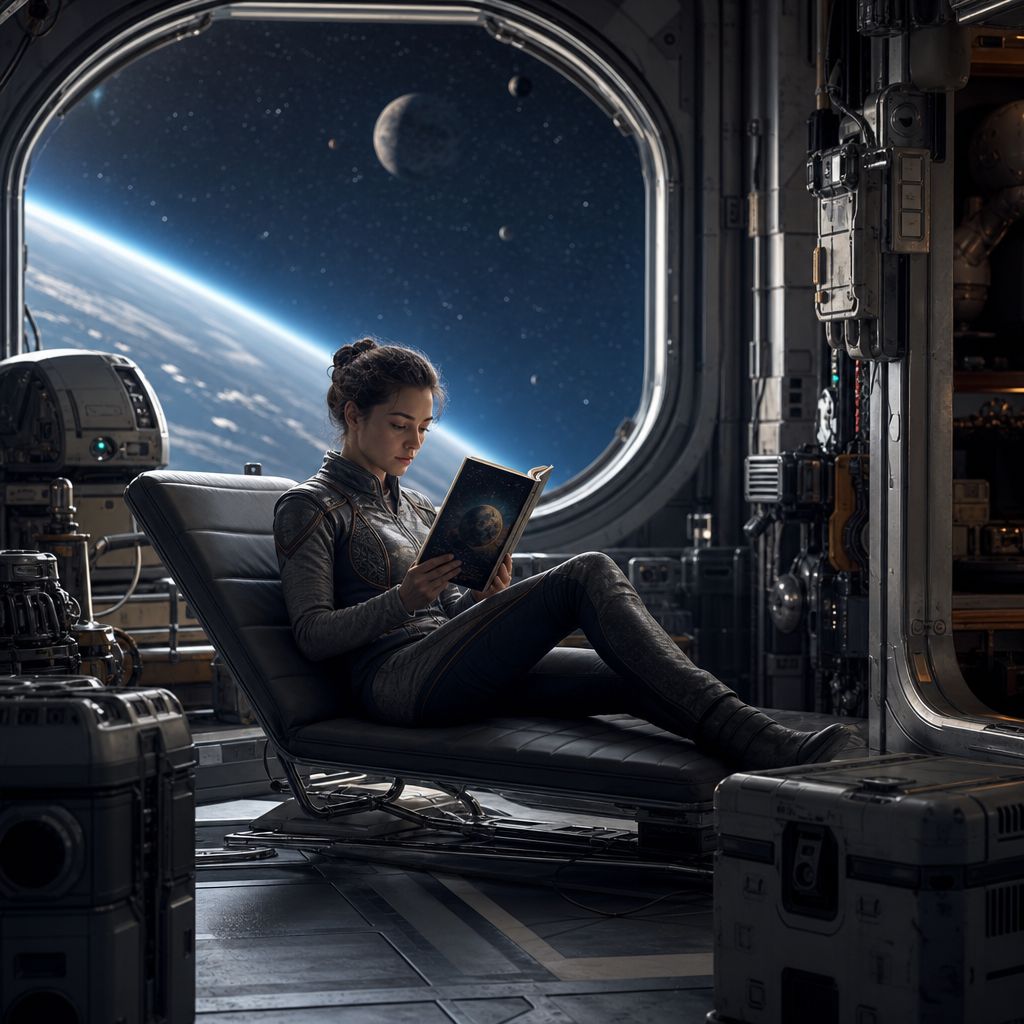
Speculative fiction in the context of the space industry encompasses narratives that project current trends in aerospace engineering, astrophysics, and human spaceflight into alternative or futuristic settings. These works often challenge conventional boundaries by proposing radical advancements, such as interstellar travel, terraforming, or the establishment of off-world civilizations. The genre is not limited to literature; it extends to film, gaming, and even conceptual design within aerospace organizations, where it functions as a sandbox for testing the feasibility and implications of emerging technologies.
At its core, speculative fiction in this domain interrogates the intersection of human ambition and cosmic reality. It addresses questions such as the sustainability of long-duration space missions, the ethical dilemmas of planetary colonization, and the potential consequences of first contact with extraterrestrial life. By blending scientific plausibility with creative freedom, the genre provides a unique lens through which engineers, policymakers, and the public can engage with the uncertainties of space exploration. For instance, works like Kim Stanley Robinson's Mars Trilogy (1990s) explore the technical and social challenges of terraforming Mars, while films such as Interstellar (2014) grapple with relativistic physics and the survival of humanity beyond Earth.
The genre also serves as a bridge between technical disciplines and public discourse. By translating complex scientific concepts into accessible narratives, speculative fiction fosters broader societal engagement with space-related topics. This is particularly relevant in an era where private companies like SpaceX and Blue Origin are accelerating the pace of innovation, often blurring the lines between science fiction and reality. For example, Elon Musk's vision of a multi-planetary human species draws direct inspiration from speculative fiction tropes, demonstrating the genre's influence on real-world technological roadmaps.
Moreover, speculative fiction in the space industry is not monolithic. It encompasses subgenres such as cyberpunk, which examines the fusion of human and machine in orbital habitats, and solarpunk, which envisions sustainable space colonies powered by renewable energy. Each subgenre offers distinct perspectives on the future of space exploration, reflecting diverse ideological and technological priorities. For instance, solarpunk narratives often emphasize ecological stewardship and decentralized governance, while cyberpunk works may focus on corporate dominance and technological dystopias in spacefaring societies.
Historical Development
The roots of speculative fiction in the space industry can be traced to the early 20th century, coinciding with the advent of modern rocketry and the theoretical foundations of space travel. Pioneers like Konstantin Tsiolkovsky, a Russian scientist and science fiction writer, laid the groundwork for both technical and narrative explorations of spaceflight. His 1920 work, The Call of the Cosmos, blended scientific speculation with philosophical inquiry, influencing generations of engineers and writers alike. Similarly, the pulp science fiction magazines of the 1920s and 1930s, such as Amazing Stories, popularized the idea of space exploration as a tangible future, albeit through often fantastical lenses.
The Space Race of the 1950s and 1960s marked a turning point for the genre. As governments invested heavily in aerospace technology, speculative fiction evolved to reflect the geopolitical and scientific realities of the time. Works like Arthur C. Clarke's 2001: A Space Odyssey (1968) mirrored the optimism and anxieties of the era, exploring themes of artificial intelligence, human evolution, and the potential for extraterrestrial life. The Apollo missions further cemented the genre's relevance, as real-world achievements in spaceflight inspired a wave of narratives that sought to imagine the next logical steps, such as lunar bases and interplanetary travel.
In the late 20th and early 21st centuries, speculative fiction in the space industry has become increasingly interdisciplinary. The rise of private space companies and the commercialization of space have introduced new themes, such as the economic exploitation of celestial bodies and the legal frameworks governing off-world settlements. Contemporary works like Andy Weir's The Martian (2011) emphasize problem-solving and resilience in hostile environments, reflecting the growing emphasis on practical challenges in space exploration. Meanwhile, authors like Ann Leckie and Liu Cixin have expanded the genre's scope to include sociopolitical critiques, examining how power structures might evolve in a spacefaring civilization.
Technical and Conceptual Frameworks
Speculative fiction in the space industry often engages with technical concepts that push the boundaries of current scientific understanding. One such framework is the Kardashev Scale, proposed by Soviet astronomer Nikolai Kardashev in 1964, which classifies civilizations based on their energy consumption. Type I civilizations harness the energy of their home planet, Type II civilizations utilize the energy of their star, and Type III civilizations command the energy of their entire galaxy. This scale has become a staple in speculative fiction, serving as a benchmark for evaluating the technological and societal progress of fictional spacefaring cultures. For example, the Culture series by Iain M. Banks depicts a post-scarcity, Type II civilization that has mastered the manipulation of stellar energy.
Another critical concept is the Fermi Paradox, which questions the apparent contradiction between the high probability of extraterrestrial civilizations and the lack of evidence for their existence. Speculative fiction frequently explores potential resolutions to this paradox, such as the Great Filter hypothesis, which posits that some barrier prevents civilizations from advancing to interstellar travel. Works like Peter Watts' Blindsight (2006) delve into the implications of the Fermi Paradox, suggesting that advanced civilizations might be inherently self-destructive or incomprehensible to human understanding.
Terraforming, the hypothetical process of modifying a planet's environment to make it habitable for humans, is another recurring theme in space-related speculative fiction. The technical challenges of terraforming, such as altering atmospheric composition, regulating temperature, and introducing liquid water, are often explored in detail. For instance, Kim Stanley Robinson's Mars Trilogy provides a meticulous account of the scientific and engineering efforts required to transform Mars into an Earth-like world. These narratives not only entertain but also serve as thought experiments, highlighting the ethical and environmental considerations of planetary engineering.
Application Area
- Inspiration for Aerospace Engineering: Speculative fiction has historically inspired real-world technological advancements. Concepts like space elevators, first popularized in Arthur C. Clarke's The Fountains of Paradise (1979), are now the subject of serious engineering research. Similarly, the idea of generation ships—self-sustaining spacecraft designed for multi-generational voyages—has influenced studies on long-duration space missions, such as NASA's 100-Year Starship initiative.
- Policy and Ethical Discourse: The genre provides a platform for examining the ethical implications of space exploration, such as the militarization of space, the exploitation of extraterrestrial resources, and the potential for biological contamination. For example, the Outer Space Treaty of 1967, which governs the activities of states in space, has been scrutinized in speculative fiction for its limitations in addressing contemporary challenges like asteroid mining and private spaceflight.
- Public Engagement and Education: Speculative fiction plays a crucial role in engaging the public with space-related topics. By presenting complex scientific ideas in accessible formats, it fosters interest and support for space exploration initiatives. Educational programs, such as NASA's collaboration with science fiction writers, leverage the genre to communicate the agency's goals and challenges to a broader audience.
- Conceptual Design and Prototyping: Aerospace organizations and private companies often use speculative fiction as a tool for conceptual design. For instance, SpaceX's vision of a self-sustaining city on Mars draws from speculative narratives to explore the logistical and technical requirements of such an endeavor. Similarly, the European Space Agency (ESA) has commissioned science fiction writers to imagine future scenarios for lunar and Martian habitats, informing their research and development strategies.
Well Known Examples
- The Mars Trilogy by Kim Stanley Robinson (1990s): This series explores the scientific, political, and social challenges of terraforming Mars and establishing a human colony. The books are renowned for their detailed depiction of planetary engineering and the ethical dilemmas of altering an extraterrestrial environment.
- 2001: A Space Odyssey by Arthur C. Clarke (1968): A seminal work that examines the evolution of human intelligence, the role of artificial intelligence in space exploration, and the potential for extraterrestrial life. The novel's collaboration with Stanley Kubrick's film adaptation further cemented its influence on both science fiction and aerospace culture.
- The Expanse series by James S. A. Corey (2011–present): This series presents a near-future solar system where humanity has colonized Mars and the asteroid belt. It explores the geopolitical tensions between Earth, Mars, and the Belt, as well as the scientific and logistical challenges of interplanetary travel and resource extraction.
- Interstellar (2014), directed by Christopher Nolan: This film explores relativistic physics, black holes, and the survival of humanity through interstellar travel. Its depiction of a wormhole and a supermassive black hole, based on consultations with physicist Kip Thorne, has contributed to public understanding of these cosmic phenomena.
- Blindsight by Peter Watts (2006): A hard science fiction novel that delves into the Fermi Paradox, first contact scenarios, and the limitations of human cognition. The book challenges conventional notions of intelligence and evolution, offering a bleak yet scientifically rigorous perspective on the future of space exploration.
Risks and Challenges
- Misalignment with Scientific Reality: Speculative fiction often prioritizes narrative engagement over scientific accuracy, which can lead to misconceptions among the public and policymakers. For example, the portrayal of faster-than-light travel in many works contradicts the known laws of physics, potentially skewing expectations about the feasibility of interstellar exploration.
- Ethical and Moral Ambiguity: The genre frequently explores controversial themes, such as the colonization of extraterrestrial bodies or the creation of artificial life. These narratives can provoke ethical debates but may also normalize problematic ideas, such as the exploitation of non-human life or the justification of unethical actions in the name of progress.
- Overemphasis on Technological Determinism: Speculative fiction often assumes that technological advancements will inevitably lead to societal progress. This perspective can overlook the complex social, political, and economic factors that shape the trajectory of space exploration. For instance, the assumption that space colonization will solve Earth's problems may ignore the need for equitable resource distribution and governance.
- Cultural and Ideological Bias: Many speculative fiction works reflect the cultural and ideological perspectives of their creators, which may not account for diverse viewpoints. For example, narratives centered on Western or corporate-driven space exploration may marginalize the contributions and concerns of other cultures and communities, perpetuating a narrow vision of humanity's future in space.
- Unintended Consequences of Inspiration: While speculative fiction can inspire real-world innovation, it can also lead to unrealistic expectations or misguided priorities. For instance, the romanticization of space colonization in popular media may divert attention and resources from addressing pressing issues on Earth, such as climate change and social inequality.
Similar Terms
- Science Fiction: A subgenre of speculative fiction that emphasizes scientific accuracy and technological plausibility. While all science fiction is speculative, not all speculative fiction is science fiction. For example, works that focus on fantasy or supernatural elements, such as alternate histories or magical realism, fall under speculative fiction but not science fiction.
- Hard Science Fiction: A subset of science fiction that prioritizes rigorous adherence to known scientific principles. Hard science fiction often explores the technical challenges of space exploration, such as orbital mechanics, life support systems, and relativistic effects. Examples include the works of Arthur C. Clarke and Greg Egan.
- Space Opera: A subgenre of speculative fiction characterized by grand, often melodramatic narratives set in space. Space operas typically focus on adventure, conflict, and large-scale world-building, with less emphasis on scientific accuracy. Examples include Star Wars and The Expanse series.
- Cli-Fi (Climate Fiction): A genre that explores the consequences of climate change and environmental degradation. While not exclusively focused on space, some cli-fi works intersect with speculative fiction by imagining off-world solutions to Earth's ecological crises, such as orbital habitats or planetary colonization.
Summary
Speculative fiction in the space industry is a multifaceted genre that blends imaginative storytelling with scientific and technological exploration. It serves as a vital tool for envisioning the future of space exploration, testing conceptual frameworks, and engaging the public with complex ideas. By addressing technical, ethical, and societal challenges, the genre inspires innovation and fosters critical discourse about humanity's role in the cosmos. However, its potential risks, such as misalignment with scientific reality and ethical ambiguity, must be carefully considered to ensure that speculative fiction remains a constructive force in shaping the future of space exploration.
--