
Deutsch: Interferometer / Español: Interferómetro / Português: Interferômetro / Français: Interféromètre / Italiano: Interferometro
Interferometer is a Device that measures the interference of waves, usually Light or radio waves, to make precise measurements of small distances, changes in distance, or to create high-resolution images. In the Space industry, interferometers are crucial for applications such as astronomical observations, satellite communications, and the detection of gravitational waves.
Description
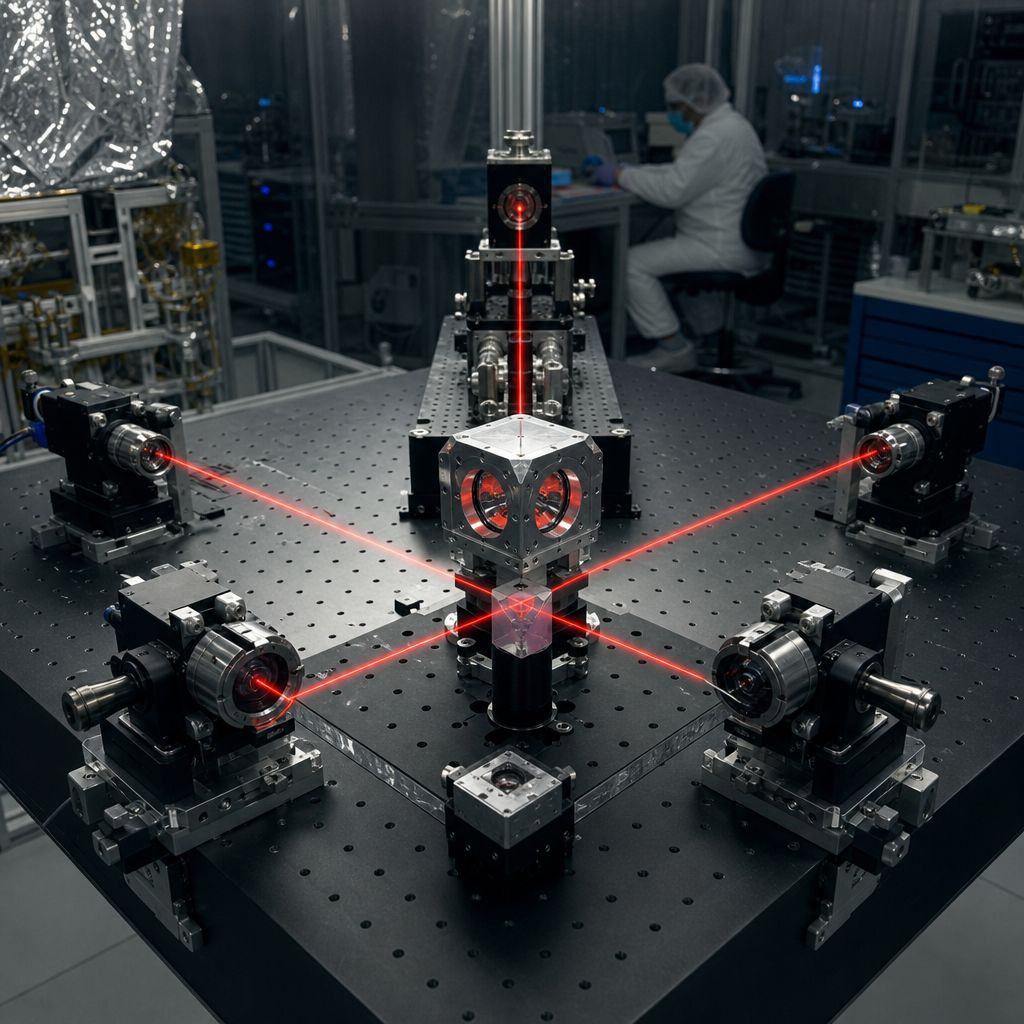
An interferometer in the space industry is an essential tool used for high-Precision measurements and observations. It works by splitting a Beam of light or radio waves into two or more paths, having those paths travel different distances, and then recombining them. The recombined waves interfere with each other, and the pattern of this interference can be analyzed to extract information about the path differences, which corresponds to distance changes, surface irregularities, or the presence of specific materials.
Interferometers have a rich history in both terrestrial and space applications. They have been pivotal in astronomy for decades, allowing scientists to achieve resolutions far beyond the capabilities of traditional telescopes. The principle of interference, where waves superimpose to form a resultant wave of greater, lower, or the same amplitude, is harnessed in various forms of interferometry, including Michelson interferometry, radio interferometry, and laser interferometry.
In the space industry, interferometers are used for multiple purposes:
- Astronomical Observations: Space-based interferometers, such as those used in missions like the Hubble Space Telescope, can measure distances and create images with unparalleled Clarity. They enable the study of distant Celestial objects and phenomena.
- Satellite Communications: Interferometers help in the precise alignment and calibration of Satellite Communication systems, ensuring accurate Data Transmission over vast distances.
- Gravitational Wave Detection: Instruments like LIGO (Laser Interferometer Gravitational-Wave Observatory) use interferometry to detect minute ripples in spacetime caused by gravitational waves, opening new avenues in Astrophysics.
Special Considerations
Interferometers in space must withstand Harsh conditions such as extreme temperatures, Vacuum, and Radiation. Designing these instruments requires advanced materials and technologies to ensure their durability and precision over extended missions.
Application Areas
- Astronomy: Used in space telescopes and observatories for high-resolution imaging and distance measurement.
- Satellite Communication: Ensures precise alignment and calibration of communication systems.
- Gravitational Wave Detection: Key technology in detecting and studying gravitational waves.
- Earth Observation: Used in satellites to Monitor and study Earth’s surface and Atmosphere with high precision.
- Space Navigation: Helps in the accurate determination of Spacecraft positions and trajectories.
Well-Known Examples
- Hubble Space Telescope: Uses interferometric techniques to enhance image resolution and detail.
- James Webb Space Telescope: Employs advanced interferometry for deep space observations.
- LIGO and Virgo: Ground-based observatories using laser interferometry to detect gravitational waves.
- ESA's GAIA Mission: Utilizes interferometry for precise astrometry, Mapping the positions of Stars with high Accuracy.
Treatment and Risks
Interferometers in space face several challenges, including:
- Environmental Stress: Exposure to extreme temperatures, vacuum, and radiation can affect the accuracy and functionality of interferometric instruments.
- Alignment and Calibration: Maintaining precise alignment and calibration in the dynamic Environment of space is crucial.
- Signal Interference: Space-based interferometers must manage and mitigate potential Signal interference from cosmic sources and onboard systems.
Similar Terms
- Spectrometer: An instrument used to measure the properties of light over a specific portion of the electromagnetic Spectrum.
- Radiometer: Measures the intensity of radiant Energy.
- Photometer: Measures the intensity of light.
Summary
An interferometer in the space industry is a sophisticated instrument used for high-precision measurements and observations. It plays a vital role in astronomical studies, satellite communications, and the detection of gravitational waves, among other applications. Despite the challenges posed by the Harsh Space Environment, interferometers provide invaluable data that enhance our understanding of the Universe.
--
Related Articles to the term 'Interferometer' | |
| 'Chemiluminescence' at quality-database.eu | ■■■■■■■ |
| Chemiluminescence refers to the emission of light during a chemical reaction without the need for external . . . Read More | |
| 'Millimeter-wave' | ■■■■■■■ |
| Millimeter-Wave in the Space industry context refers to the band of radio frequencies in the electromagnetic . . . Read More | |
| 'Reflection' | ■■■■■■■ |
| Reflection in the Space industry refers to the process by which Light, radio waves, or other electromagnetic . . . Read More | |
| 'Photodetector' | ■■■■■■■ |
| A photodetector is a device that converts light into an electrical signal, playing a crucial role in . . . Read More | |
| 'retroreflector' | ■■■■■■■ |
| A retroreflector is a specialized optical device designed to reflect incident light or electromagnetic . . . Read More | |
| 'Photometer' | ■■■■■■■ |
| Photometer: A photometer is an optical instrument designed to measure the intensity of light or its spectral . . . Read More | |
| 'High-resolution' | ■■■■■■■ |
| High-resolution: High resolution refers to the level of detail and precision in an image, measurement, . . . Read More | |
| 'Anechoic' | ■■■■■■ |
| Anechoic refers to a material or surface that is designed to absorb or reflect electromagnetic waves, . . . Read More | |
| 'Auger' at quality-database.eu | ■■■■■■ |
| Auger in quality management refers to an analytical technique known as Auger Electron Spectroscopy (AES) . . . Read More | |
| 'Disruption' at quality-database.eu | ■■■■■■ |
| Disruption in the context of quality Management refers to any event, change, or interference that interrupts . . . Read More | |
Do you have more interesting information, examples? Send us a new or updated description !
If you sent more than 600 words, which we can publish, we will -if you allow us - sign your article with your name!